
Banner image

Aquaculture Happy Dance - 23rd species spawned! (1 Viewer)

mpedersen

Mr. Oxymonacanthus
Lifetime Member
Joined
Aug 4, 2009
Messages
1,534
Location
Duluth, MN (formerly Chicago, IL)
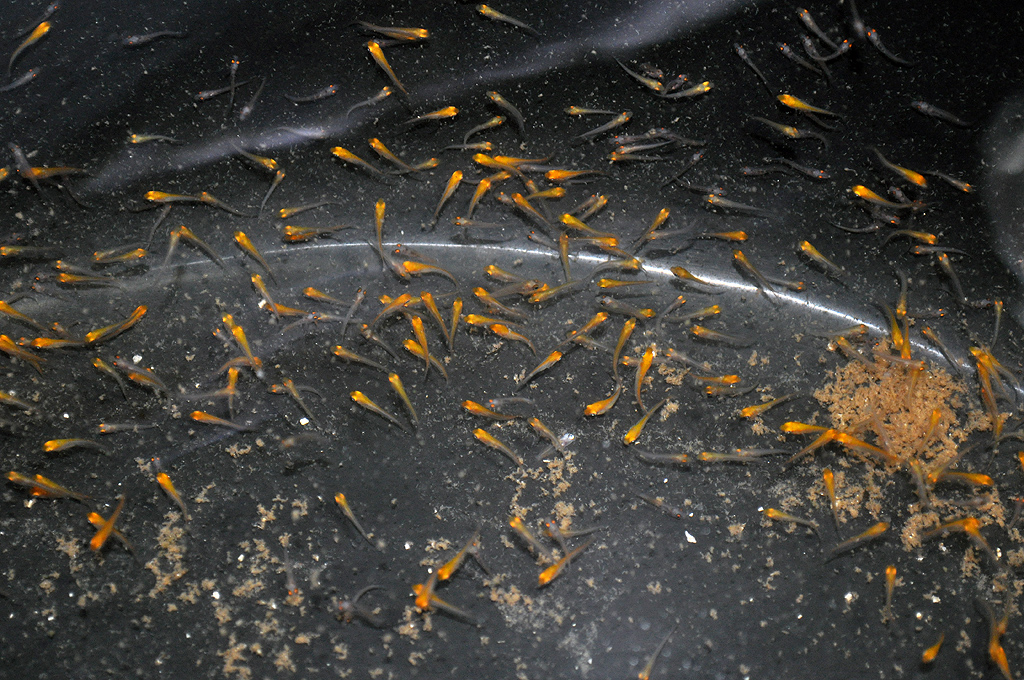
So this evening, I had a hunch that a pair of Maroons was spawning. Thought about it, moved one piece of live rock, turned over another and shazam...Premnas biaculeatus makes it to the list. NO it's not the Lightning. Of course, it's a pairing of a PNG Male with a Sumatran Gold Stripe Female, so even if I do raise the babies I will be feeding them all to Lionfish and Groupers. Still, I may do so in an effort to "get the hang" of rearing Maroon Clowns. I'm gonna go back down and shoot some video, which I may post later tonight or sometime tomorrow...
 
very nice, interesting to see what percentage takes on gold vs white bar. That is one of the PNG that came with the juvi group you ordered correct?
 
Indeed, it's a Sumatra GSM X PNG WSM. I won't be rearing them long enough to answer that question...don't want to be responsible for hybrid maroons getting out there. My current plan, if I rear them at all, it will be to 60 days post settlement and then they get fed to Lionfish or culled or euthanized. Unless someone out there is responsible enough to raise the whole batch for a year or two to answer your question and then put 'em down responsibly. Lot of potential here to muck up populations on either side of things. Only reason I put 'em together was so that the female would keep the PNG one male. I now have, without a doubt, one solidly confirmed fertile male PNG Maroon ;)
 
ahh i see, good luck then! experience will come in handy if and when the lightning maroon decides to spawn. have you tried him with the lab maroon to see where he/she places in the sex change? who knows, he(if it still one) may spawn for you as well.
 
congrats Matt!

still have all those dottybacks? should post some pics here too!
 
have you tried [the lightning maroon] with the lab maroon to see where he/she places in the sex change?

Yes - http://www.youtube.com/watch?v=nFMZxnPeREE

Showed up with a few nicked fins after an hour or two and was returned to the basket. Don't know if the split fins were from the Lab Maroon or the Centropyge angelfish in the tank. Then was getting fins nipped THROUGH the basket, which I figured out was actually the Bristletail Filefish.

That is one of the PNG that came with the juvi group you ordered correct?

Yes, if I didn't say so already before.

congrats Matt!

still have all those dottybacks? should post some pics here too!

Which Dottybacks, these?

DSC_0323_Ps_flavivertex_10-26-2010.jpg
 
If you don't mind me asking... why would you need to put them down? Am I missing something in the fish breeding process?

Couldn't they just go to a LFS to be sold to hobbiests as I know Hybrid dogs go for good money...
 
Congrats Matt.

Cdness- Some folks are against hybridization as it dilutes the genetics of a fish from a particular area. If one believes captive breeding is about preserving a species hybridization could be viewed as a negative thing as you are no longer preserving the gentics of an area but rather diluting it with genes it would have never encountered. And it is being done for the sake of prettiness in an animal that could and should be appreciated for it's beauty in it's natural form instead. At least that's my opinion on it (and only my opinion.) I think there are some beautiful hybrids out there also for the record, it's just not my thing.
 
Only slightly tangential but...

I had always been under the impression that a species was defined as creatures capable of breeding and having reproductive offspring.

That being the case since it seems all clowns can interbreed, would that not make them all the same species? Is my understanding of what a species is incorrect/out of date?
 
As defined by biology-online.org

Species

Definition

noun, singular or plural: species

(taxonomy)

(1) The lowest taxonomic rank, and the most basic unit or category of biological classification.

(2) An individual belonging to a group of organisms (or the entire group itself) having common characteristics and (usually) are capable of mating with one another.


The differences in characteristics would be the main omission in your definition.


I was recently surprised the other day by the amount of crossbreeding/hybridization going on in the FW fish hobby. Not to mention that it is actually encouraged by inflated prices for hybrids. Ive always thought that wild type fish were always more interesting than hybrids or selectively bred fish strains. I'm glad to see you are refusing to release this spawn into the community, especially considering how important captive breeding is and will increasingly become to this hobby.

-Nick
 
Last edited:
Cross species breeding can happen...Horses can crossbreed within their Genus (mules, zorses.) I should have said line preservation or genetic preservation not species. Each group of fish comes from a specific genetic pool. These are both Premnas biaculeatus but from two isolated genetic pools. By mixing the pools you are creating offspring that would likely have not occurred in nature...again this is all my opinion and that only :)

Also I don't believe that all clowns can breed with one another...only variants within a species.
 
Last edited:
Alright that all makes sense... I am slowly coming to see why some people want wild fish when intending to breed. Though I wonder is it that they truly want wild, or they simply want fish they can guarantee is not a cross, i.e. would they be happy with captive bred if they knew the lineage and it matched what they wanted?

Though I could see passing along some of these "one offs" if you got a guarantee they would never be allowed to successfully breed.

Anyway, kudos for being aware and taking action to preserve something you hold dear. And thanks for all the info.
 
Matt- I'm still a bit confused why you don't have a dedicated tank setup for JUST the lightening maroon pair - whatever you finally decide that is going to be. It seems to me like the risk you are taking with having other species of animals in the tank (ones that are known nippers even) is rather high for a truly one-of-a-kind fish. Also, you already have a spawn from a different PNG male maroon, couldn't that be the lightening in there? That way even if you are going to cull them all, you could at least start the process of determining the genetic link to the pattern. I think the world wants to see some babies already :)
 
Matt- I'm still a bit confused why you don't have a dedicated tank setup for JUST the lightening maroon pair - whatever you finally decide that is going to be. It seems to me like the risk you are taking with having other species of animals in the tank (ones that are known nippers even) is rather high for a truly one-of-a-kind fish. Also, you already have a spawn from a different PNG male maroon, couldn't that be the lightening in there? That way even if you are going to cull them all, you could at least start the process of determining the genetic link to the pattern. I think the world wants to see some babies already :)

The female the male PNG spawned with is Sumatran though.
 
I think you may have missed the point of my post a little. It doesn't matter at all where the mate is from. Right now the lightening maroon is just in a giant holding pattern - in a somewhat risky environment IMO due to a non-species specific tank. Instead, attempt to make some forward progress with the clown, somehow. The current pairing of PNG male/Sumatran female will (from what it sounds like) have all of the offspring culled. As long as this is happening, I think it should be the lightening in the male role. Matt could still cull all the offspring due to his belief of not wanting to mutt-up the genetics (they are both the same species though, right?).

Even still, there are several huge advantages:

1) the lightening gets some practice. As any accomplished breeder can tell you, an inexperienced clown generally just doesn't do well. The lightening maroon will be taught from the known female, so when it finally gets its coveted PNG female, it will hit the ground running knowing exactly what to do.

2) ideas on genetics can be tested. From raising multiple clutches, if any of the young offspring show lightening traits it becomes even more exciting to get that PNG female. The "mutts" can still be culled, but at least then it's known whether or not the lightening pattern can be passed down.

I really don't see any downside to attempting to breed the lightening as soon as absolutely possible. It's not like he's only got a limited number of spawns in him - put him to work finally.
 
Cross species breeding can happen. Each group of fish comes from a specific genetic pool. These are both Premnas biaculeatus but from two isolated genetic pools. By mixing the pools you are creating offspring that would likely have not occurred in nature...again this is all my opinion and that only :)

Everything you stated isn't actually an "opinion"...everything you wrote in the above quote is FACT.

Also I don't believe that all clowns can breed with one another...only variants within a species.

Some species can freely interbreed back and forth. Amphiprion percula and A. ocellaris are well documented now...they WILL become the first marine "guppy" if they technically haven't already.

Alright that all makes sense... I am slowly coming to see why some people want wild fish when intending to breed. Though I wonder is it that they truly want wild, or they simply want fish they can guarantee is not a cross, i.e. would they be happy with captive bred if they knew the lineage and it matched what they wanted?

TOTALLY RIGHT. Here's a good example. The new Amphiprion pacificus, split off from Amphiprion akallopisos. Turns out it's really easy to tell the two species apart...because they come from different OCEANS. Genetically they are distinct too, but outwardly, visually, they are identical to the untrained eye. The net result - every generic captive bred "Akallopsisos" clownfish is now called into question UNLESS location data of the broodstock and any subsequent generations was retained from day 1. If I was a breeder wanting to breed and preserve A. akallopsisos or the related A. pacificus, the only way I can reasonably know which species I'm working with, and the only way I can ensure I'm not already working with hybrids, is to purchase fish with known collecting locations from trustworthy sources.

Though I could see passing along some of these "one offs" if you got a guarantee they would never be allowed to successfully breed.

And therein lies the problem...how do I guarantee that? How do I guarantee that these fish, which will likely look like one parent or the other, won't somehow get back out there and to other breeders and inadvertently misrepresented as purebred "white stripe" or "gold stripe" Maroons? What happens if someone takes two of the offspring from this hybrid pair that maybe show yellow stripes, breeds them assuming they're straight up gold stripes, and then 2 years in comes to find out that all of the offspring are still white striped? That's not going to happen if you're working with nice clean Gold Stripe Maroons...but that quite easily COULD happen if hybrids are allowed to get out there. I bet, 10 years from now, good luck finding a nice clean non-frills Ocellaris Clownfish...such a thing might not even exist except back in the oceans!

Anyway, kudos for being aware and taking action to preserve something you hold dear. And thanks for all the info.

Freshwater fish breeders for the most part "get it" and are very stringent about this. Of course, there are examples of things going bad, and there are also examples of newbies and cons, mostly driven by MONEY and GREED, who do muck it up for the rest of us. Our hobby MUST continue to be conservation oriented and must do a better job of "preemptive" actions to ensure we can actually function in that manner. Still, there is a different line for each person. A good example - Martin Moe will only keep local marine fish in his fishroom so as to not introduce different diseases from the Indo-Pacific into Florida (although, if I'm candid, I'm pretty sure that ships and other less thorough individuals pretty much ensure that this extra effort is foiled).

Matt- I'm still a bit confused why you don't have a dedicated tank setup for JUST the lightening maroon pair - whatever you finally decide that is going to be. It seems to me like the risk you are taking with having other species of animals in the tank (ones that are known nippers even) is rather high for a truly one-of-a-kind fish.

Actually, I think you need to go read up on the Lightning Project, but let me state here that the Lightning Maroon initially did have its own tank and was later moved. It currently resides in a large enclosure. The "fin nippers"...well I assume you are referring to the Bristletail Filefish. They actually were NOT problematic nippers..but became so. However, the real frustration was that they were nipping through the protective eggcrate cage. Seriously...through the bars. When that was discovered they were moved immediately. As far as a separate tank...without going into detail one has been in the works now for months, and in fact, the first one got crushed by the freight company. So for now, the Lightning Maroon lives in the protective cage with the large Labrador Maroon outside.

Also, you already have a spawn from a different PNG male maroon, couldn't that be the lightening in there? That way even if you are going to cull them all, you could at least start the process of determining the genetic link to the pattern. I think the world wants to see some babies already :)

You have a semi-valid point there, at least from the standpoint of seeing babies already. Still, the spawn JUST happened, I'm not about to go swapping mates when I already made the concession to try to breed it to the Labrador Maroon which isn't from PNG. They can interact between the bars...it's probably just a matter of time before that female starts spawning too (hopefully).

I think you may have missed the point of my post a little. It doesn't matter at all where the mate is from. Right now the lightening maroon is just in a giant holding pattern - in a somewhat risky environment IMO due to a non-species specific tank.

Again, you either aren't understanding the current setup or are drasticaly overestimating the "risk" given that any fish that could cause serious damage, including a larger Maroon, cannot physically interact with it.

Instead, attempt to make some forward progress with the clown, somehow. The current pairing of PNG male/Sumatran female will (from what it sounds like) have all of the offspring culled. As long as this is happening, I think it should be the lightening in the male role. Matt could still cull all the offspring due to his belief of not wanting to mutt-up the genetics (they are both the same species though, right?).

Ah, but there is always a risk to trying something like this. It could quite easily happen that the Sumatran Female might get ANGRY over the loss of her mate and opt to kill the Lightning Maroon vs. breed with it. It's not so cut and dry.

1) the lightening gets some practice. As any accomplished breeder can tell you, an inexperienced clown generally just doesn't do well. The lightening maroon will be taught from the known female, so when it finally gets its coveted PNG female, it will hit the ground running knowing exactly what to do.

Technically we still do not know if the Lightning is even a male....so you're already jumping the gun. I *think* it's a male...but we lack proof. THAT is what I'm working on NOW by having the largest female Maroon, the Labrador, just outside.

Second, you're also assuming that this clown has never ever mated...I'm going to guess that probably it WAS spawning somewhere when it was collected. We're not talking about a young captive bred fish...we're talking about a wild caught fish of unknown age.

2) ideas on genetics can be tested. From raising multiple clutches, if any of the young offspring show lightening traits it becomes even more exciting to get that PNG female. The "mutts" can still be culled, but at least then it's known whether or not the lightening pattern can be passed down.

Good point, but not 100% accurate. If the trade is recessive, it may take more than one generation to show up. It's presumptive to assume that we'll know one way or another from a single mating with some random mate.

I really don't see any downside to attempting to breed the lightening as soon as absolutely possible. It's not like he's only got a limited number of spawns in him - put him to work finally.

Again, I am, in a different capacity. Remember, the female Sumatran (Gold Stripe) was put in place specifically to keep the small PNG Maroon a male. IF I were to allow the Lightning to become a female, I now have a known PNG male that's "experienced" to place with the Lightning Maroon. It's not as direct a route as you perhaps would take, but I'm playing with a lot more than just a single fish. I also happen to be trying to force another pairing of PNG Maroons to happen so as to CREATE a female PNG Maroon if I'm unable to get one of size. it's slow going, but I think it's starting to happen finally.

There are MANY pieces to this puzzle...if you only focus on short term gratification you may miss the real prize.

FWIW,

Matt
 

Users who are viewing this thread

Back
Top