
Navigation
Install the app
How to install the app on iOS
Follow along with the video below to see how to install our site as a web app on your home screen.

Note: This feature currently requires accessing the site using the built-in Safari browser.
More options

You are using an out of date browser. It may not display this or other websites correctly.
You should upgrade or use an alternative browser.
You should upgrade or use an alternative browser.
Aquaculture Joculator angelfish breeding and rearing? (1 Viewer)
- Thread starter Chad Vossen
- Start date
OP
OP

How hard is it to raise these copepods in large quantity?
Are you growing algae to feed them?
Good luck with the baby fish - this is very exciting stuff!
http://www.tcmas.org/v4/forums/showthread.php?60506-Finally-set-up-a-Phyto-station
Phyto station is going very well. Shocked I have not had a culture crash yet. Parvocalanus is also doing well, and I have 40 gallons dedicated to culturing them right now. Looking to double that soon though.
OP
OP
Nice pics. Would love to see one of the parvo nauplii with the larvae.
Pure luck that a first stage parvo nauplii was sucked up with the larval angelfish!


Very cool, always interested in seeing the actual sizes. Its one thing to read about what size prey they need, another to see it in pics.
When you feed the larval tank, do you specifically try to limit the sizes of the parvo you add, or do you just put them all in? In thinking about the mandarins I found myself thinking it would be good to control the feed, but not sure if its needed really.
When you feed the larval tank, do you specifically try to limit the sizes of the parvo you add, or do you just put them all in? In thinking about the mandarins I found myself thinking it would be good to control the feed, but not sure if its needed really.
OP
OP
Very cool, always interested in seeing the actual sizes. Its one thing to read about what size prey they need, another to see it in pics.
When you feed the larval tank, do you specifically try to limit the sizes of the parvo you add, or do you just put them all in? In thinking about the mandarins I found myself thinking it would be good to control the feed, but not sure if its needed really.
I just feed all sizes. Having adults in the larval tank is good, as they are constantly producing more nauplii. Adding all naups to the tank is only good for a few days as they'll outgrow the fish larvae.
OP
OP

OP
OP
Larval fish are kept in the beakers for now, till their eyes develop.


OP
OP
How dense are you able to get the copepods in your copepod tanks? (I'm not sure what sort of measurement I'm expecting in your answer here - however you can describe it is good!)
I have not reached peak density yet, I keep splitting cultures to prevent over crowding. In ideal conditions, you can get 40 or more per ml.
Wow, 40 per ml is a crazy high density - higher than I had imagined.
I would imagine cultures at that density could be a bit precarious - very subject to crashing if not tended really carefully - but I can see how such cultures could be very viable food sources for getting even a fairly large number of young fish through their earliest stages.
Presumably once the young put on a bit of size baby brine shrimp will work? At that point everything would become much much easier.
How long have people been culturing this sort of copepod like this? This ability to produce marine copepods at high densities seems like it must be sort of a revolutionary breakthrough for rearing larval marine fish (particularly for possibly making captive propagation possible in inland areas where wild plankton is not available).
I would imagine cultures at that density could be a bit precarious - very subject to crashing if not tended really carefully - but I can see how such cultures could be very viable food sources for getting even a fairly large number of young fish through their earliest stages.
Presumably once the young put on a bit of size baby brine shrimp will work? At that point everything would become much much easier.
How long have people been culturing this sort of copepod like this? This ability to produce marine copepods at high densities seems like it must be sort of a revolutionary breakthrough for rearing larval marine fish (particularly for possibly making captive propagation possible in inland areas where wild plankton is not available).
Last edited:
OP
OP
The larger adult copepods are about the size of baby brine shrimp. I typically avoid baby brine shrimp due to poor nutrition, however I may feed small amounts later if I struggle to maintain copepod populations.Presumably once the young put on a bit of size baby brine shrimp will work? At that point everything would become much much easier.
I don't know the exact history, but I think they're pretty new to hobbyist, and were a "trade secret" for years.How long have people been culturing this sort of copepod like this? This ability to produce marine copepods at high densities seems like it must be sort of a revolutionary breakthrough for rearing larval marine fish (particularly for possibly making captive propagation possible in inland areas where wild plankton is not available).
When I had a batch of engineer goby fry the summer before last, I was trying to feed them baby brine shrimp, which I was not enriching in any way. I had gradual attrition of numbers of fry, and though I had a few live a month I had none survive. There were multiple things I was doing wrong (which I was painfully aware of at the time, but had limited time to devote to this that summer), but I also worried that nutrition might have been a good part of my problems.
More fundamental than nutrition though (or at least equally important) was that I think the young fish basically needed to have access to food most of the time (or at least 3 or 4 feedings a day), and I wasn't pulling that off very well.
One member of the pair (which were Dwight's pair originally - and they spawned in his tank once too) has now disappeared though - a real bummer. So, I won't be getting more opportunities to try to get this right.
More fundamental than nutrition though (or at least equally important) was that I think the young fish basically needed to have access to food most of the time (or at least 3 or 4 feedings a day), and I wasn't pulling that off very well.
One member of the pair (which were Dwight's pair originally - and they spawned in his tank once too) has now disappeared though - a real bummer. So, I won't be getting more opportunities to try to get this right.
(Incidentally - for at least a year prior to this spawning that engineer goby pair had been living on a diet of Tetra Color Bits. I'm not saying this to suggest that this is how they should have been fed, but I found it interesting that they spawned and produced a large number of fry being fed a food that does not necessarily get a lot of respect, particularly in marine circles. This is a food I have really liked for many years for freshwater angelfish though - which I used to breed extensively - and originally it was marketed years ago as "Discus Pellets", designed supposedly with the needs of discus in mind.)
OP
OP
Larvae finally have eyes, mouth, and digestion system. They have been released into the tub to begin hunting for food. Likely the last photo I'll share for a while till they are big enough to get pics of in the larval tanks.
I see they are also starting to get white/silver pigment on the bodies. in a few weeks they will be silver circles swimming around in the tank.
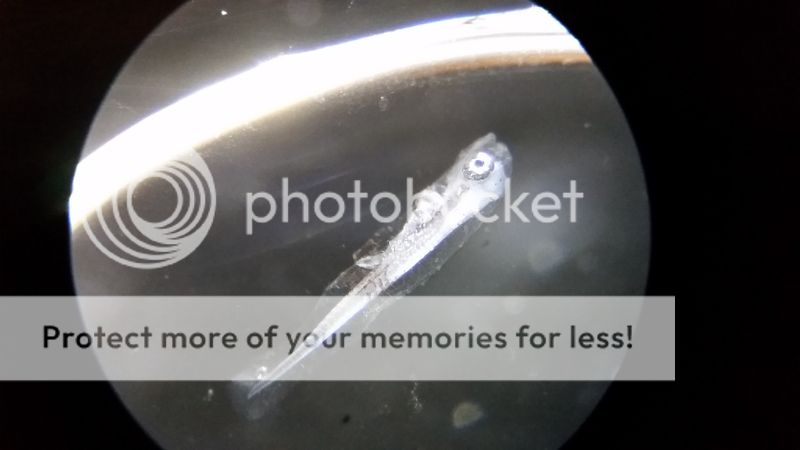
I see they are also starting to get white/silver pigment on the bodies. in a few weeks they will be silver circles swimming around in the tank.
OP
OP
I may go back to Jon's this weekend to collect more eggs. I added both night's worth of larvae to one tub, so it may be nice to have another batch one week behind in case I hit a bottle neck with the first batch. It would be nice to have a week's notice if I'm about to run into a problem instead of having to start over.

Thanks Chad for the interesting read as always

Thoughts on live cam like they did for the bald eagle nest? maybe hooked up to a microscope...
OP
OP
Well, the trial run may have come to an end. As of a couple days ago, I could only locate two larvae. Sunday's spawn gave me a ton of larvae, however I don't think they handled acclimation to the tub as well as the first spawn did. The next day I had most of the larvae stuck to the surface tension. The biggest lesson here to to use more phyto in the larval tubs next time.
There may still be 1-2 larvae left in the tub, however I have not seen either of them in the last 24 hours. They are crazy hard to find, so it's possible they're still going.
There may still be 1-2 larvae left in the tub, however I have not seen either of them in the last 24 hours. They are crazy hard to find, so it's possible they're still going.

If one is still in there I call dibs on the naming rights to Waldo.
Sent from my SCH-I535 using Tapatalk
Sent from my SCH-I535 using Tapatalk
Users who are viewing this thread
Total: 2 (members: 0, guests: 2)