

Banner image

Purple vase sponge not doing well (1 Viewer)

ConnorG

Senior Member
Joined
Apr 22, 2012
Messages
945
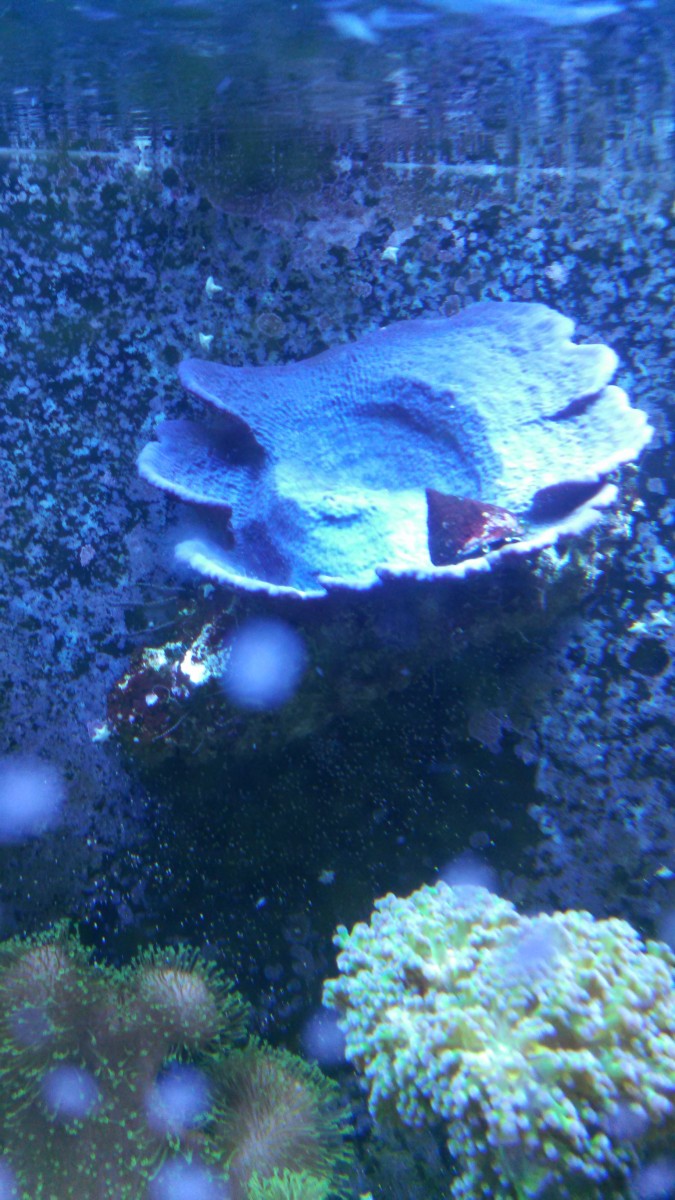
I bought a purple vase sponge from New Wave a few weeks ago and it was doing great up until today. It's in a high flow high light location and it's purple color was great. Today however I noticed a hole that started to form from one of the sides. I have no idea what this could be. Water parameters are normal:
pH: 8.1
Salinity: 1.025
Alk: 8.6
Cal: 440
Mag: 1200 (dosed to raid to 1350 over the course of a few days)
PO4: .15 (running GFO )
Ammonia: 0
Nitrite: 0
Nitrate: 15
It has a Jebao wp20 on the opposite side of the tank pointing at it. Could I be too much flow? Here is a picture.ImageUploadedByTapatalk1423012137.150380.jpg
Thanks,
Connor


Sent from my iPhone using Tapatalk
 
Last edited:
Mine gets small holes every now and then. So far they have always healed up within in a few days. Don't know what causes them.
 
mrbill,

How long have you had yours? And has it grown any? (If so, I think I'd be really interested in trying to get one of these sponges.)


I have no experience trying to keep this particular sponge, but my experience has been that basically every ornamental sponge I have bought over the years has starved to death - in some cases quite quickly.

Sponges don't look like they are doing much, but they are very busy critters. They are expending a lot of energy pumping water, which is why they can starve quickly if they are not getting enough food that is appropriate for them. The only sponges I've had that have done well long term are several species that have cropped up on their own on live rock, or that had cropped up like this in other people's tanks who I got the sponges from. I have several sponges that grow to decent sizes that do extremely well in my tanks (one of which that grows particularly well has symbiotic cyanobacteria in it, which helps with its nutrition, though this species also can grow well in the dark without significant amounts of its symbionts).

Check out my sponge video (of a sponge I no longer have) to see how much work even a very small sponge is doing, more or less constantly:

[video=youtube;A7UsN87M5w8]https://www.youtube.com/watch?v=A7UsN87M5w8[/video]
 
Last edited:
mrbill,

How long have you had yours? And has it grown any? (If so, I think I'd be really interested in trying to get one of these sponges.)

This one is different. It can handle being out of the water, it holds up to fragging well. I got a piece that was about 1-2 inches in diameter, it ended up closer to 12 inches before I cut the outer ring off of it and started over. I think that took about a year, or less.

Crap picture from before I cut it. Yes, that is a big snail on it.

 
Last edited:
Mine do that, sometimes it grows back and fills in and sometimes it just keeps on going. No clue which parameters are off to cause it. Haven't pin pointed what it could be. They definately seem fickle to me.
 
Last edited:
This one is different. It can handle being out of the water, it holds up to fragging well. I got a piece that was about 1-2 inches in diameter, it ended up closer to 12 inches before I cut the outer ring off of it and started over. I think that took about a year, or less.

Crap picture from before I cut it. Yes, that is a big snail on it.


Wow, this sounds like a seriously cool sponge. I'd love to get a piece of this to try in the lab tanks if anyone has any to spare at some point.
 
Mine do that, sometimes it grows back and fills in and sometimes it just keeps on going. No clue which parameters are off to cause it. Haven't pin pointed what it could be. They definately seem fickle to me.

It looks like it's just cutting itself in half, should I just reattach both halves? Do they require any feeding?


Sent from my iPhone using Tapatalk
 
I don't have any experience with this particular sponge, though sponges in general (with a few exceptions) feed on very small particles, most typically bacteria sized (though I imagine very tiny phytoplankton is probably consumed by some).

I'll be interested in hearing whether anyone here has attempted to feed these, and whether it seems to have worked (e.g. resulting in more growth.... one challenge here might be in not having an experimental control group living in the same conditions other than not being fed).

My guess is that in some cases, attempts at feeding sponges in aquaria might improve sponge growth not so much because of direct consumption of the foods being fed, but because the foods being fed increase the abundance of bacteria (or maybe other very tiny organisms) in the system which in turn are consumed by the sponges.


Again, I'm always really intrigued by any large sponges that people (at least some people) are having success with in their tanks - sponges that actually grow, and not just sit there and stay alive for awhile, or that slowly (or rapidly) starve. It appears this one is colorful too - so cool.

I've had maybe a half dozen or so large-ish sponges (bigger than the ones that just encrust rocks) do well in my tanks (sometimes for years) at various times over the years, but only two of them have had really good long term persistence in my tanks. One is not very decorative looking at all (but it grows really really well and is still greatly appreciated), while the other is an attractive pale yellowish greenish color (never grows huge, but is a decent size). It's always so disappointing to me that more sponges won't grow in our tanks, since sponges, big and small and of many shapes and colors, are basically just everywhere (normally on firm surfaces) and surprisingly diverse in the wild (in the ocean that is).
 
Last edited:
Bill, This particular sponge is photosynthetic so probably a bit hardier than most. I have 20+ frags of it in my sump but they lost color. If they pull through, one will have your name on it.
 
If this purple vase sponge grows so well in some people's reef tanks, I wonder whether it might have photosynthetic symbionts (there are quite a few sponges that do).

EDIT: David and I posted at the same time.
 
Yes Bill definately is photosynthitic, kinda like a clam when view from above it is awesome blue when viewed from the typical front pane view its purple.
 
Thanks David. Greatly appreciated.

The fact that it is photosynthetic almost certainly explains how people are having such success with it - it just seems that our tanks rarely provide enough appropriate food for most of the larger sponges.

Incidentally, regarding feeding: Some years back I tried enhancing the growth of some of the sponges in my tanks using Spirulina powder. This seemed to cause definite harm to some of them, resulting in serious dieback in some cases. I have no idea why. I don't see this as evidence that attempting to feed sponges is necessarily bad, but rather that Spirulina, particular, didn't seem good for my sponges.

I need to make it up to your place sometime to see your tanks. It's been a long time.
 
Last edited:
When feeding sponges, use rotifers. I noticed an explosion in growth years back when I dosed rotifers to my reef. Filter feeding sponges that were doing OK suddenly hit a growth spurt.

In regards to collospongia auris, it's a photosynthetic sponge that will grow in the shape of a vase, or much like a montipora cap. I have noticed it's vulnerable to red slime treatments, but is typically a fast grower. So far, In high light, it'll develop a blue color, while in lower light, it's purple. It can become highly invasive and difficult to kill in certain situations, so be careful where you place it. I feel like this sponge should be in everyone's soft coral tank. Sanjay keeps it in his 500 gal SPS tank, and it looks awesome.

http://reefbuilders.com/2010/12/15/blue-photo-sponge-collospongia-auris/

I think that due to the bad rep of most sponges that are collected in the wild, this purple sponge gets passed on because people think it'll just die like the other sponges. Of all the sponges available in the hobby, this is the easiest. There is just no easier way to add a splash of blue to a tank besides using blue mushrooms.

102.jpg
 
I'd also like to mention that I'm the one who brought this sponge to MN. I bought it from a guy in MI that was trying to get $1000 for his 12" diameter sponge, but ended up selling chunks for $100 each.

The first frag swap, I sold 10 frags of it, which is how it got established in MN. Jen has lots of it throughout a few clients tanks now, and that's where she gets it from. It's 100% aquacultured sponge.

Source - http://www.reef2reef.com/forums/selling-forum-livestock/116098-purple-vase-sponge-mini-colonies.html
 
Last edited:
Chad,

Regarding the origins of the sponge in the area: That's really super cool that you brought it in and distributed it. It looks like a really awesome sponge.

Regarding feeding rotifers to sponges: I certainly don't know everything to know about all the sponges out there (or even that terribly much about most of them), but I would be very surprised if most sponges could actually eat rotifers. Rotifers are pretty big, and the ostia of sponges are very small (microscopic, basically). I'm wondering whether the real effect came from the water the rotifers were in - e.g. algae or other foods the rotifers were being fed, or bacteria growing with the rotifers? It seems like the water from rotifer cultures could be laden with perfect sponge foods. (I'm happy to be proven wrong though - if there actually are sponges that can eat rotifers it would be cool to know!).
 
Last edited:
mrbill,

How long have you had yours? And has it grown any? (If so, I think I'd be really interested in trying to get one of these sponges.)


I have no experience trying to keep this particular sponge, but my experience has been that basically every ornamental sponge I have bought over the years has starved to death - in some cases quite quickly.

Sponges don't look like they are doing much, but they are very busy critters. They are expending a lot of energy pumping water, which is why they can starve quickly if they are not getting enough food that is appropriate for them. The only sponges I've had that have done well long term are several species that have cropped up on their own on live rock, or that had cropped up like this in other people's tanks who I got the sponges from. I have several sponges that grow to decent sizes that do extremely well in my tanks (one of which that grows particularly well has symbiotic cyanobacteria in it, which helps with its nutrition, though this species also can grow well in the dark without significant amounts of its symbionts).

Check out my sponge video (of a sponge I no longer have) to see how much work even a very small sponge is doing, more or less constantly:

[video=youtube;A7UsN87M5w8]https://www.youtube.com/watch?v=A7UsN87M5w8[/video]

I got mine as a quarter sizes frag from Chad Vossen about two years ago. It didnt do much in my biocube 29g but when I stuck it in my display it took off. Its about 6" X 6" and originally had a perfect vase shape until a piece of rock fell on it and folded it flat. I was able to get it rounded out pretty well but it still has a crease in it. My naked clown sleeps in it.

sponge.jpg
[/URL][/IMG]
 
I would be interested in getting a piece of this as well David, curious to see how it would fare in my 15 zoa garden to be. Lower light, medium flow. I have some small patches of misc sponge throughout.
 
mrbill,

That is a seriously awesomely cool sponge. Thanks for posting that great photo. I'm very excited about eventually giving this a try in our tanks. If it grows well, it will be an incredibly useful addition to the tanks - the sponges we have are nice, but this one would give students a much better sense of what things are like in nature, with large sponges often being really significant features in the underwater landscape.

The fact that it is blue/purple is just icing on the cake (very nice icing, I will add). I'm imagining growing this side by side with a hot pink birdsnest coral...
 
So the receding has stopped and he is starting to puff back up again and grow back together! Thanks for all the help!


Sent from my iPhone using Tapatalk
 
Glad to hear it's on the mend. Take some photos so you can remember what it looked like before it grows up.
 

Users who are viewing this thread

Back
Top