

Banner image

The Camera Doesn't matter.... (1 Viewer)

Zibba

I contributed!
Lifetime Member
Joined
Jun 8, 2007
Messages
2,267
Location
Arizona
... as Ken Rockwell said.

First off, the point of this thread is to show you that to get good pictures you don't need to spend all kinds of money. I recently got a Nikon D90 (upgraded from a Nikon D40x) and I'm still in the early stages of learning the new features and developing different techniques. I realized that there's still a lot to learn about the new camera and have been trying to figure out what settings will get me that "perfect" picture (...subjective, I know). I am obviously still really far away from getting decent results with my new camera but I know it will come with time. But, that's not really what this is all about. What it IS about, is showing you that decent pictures can be had with non-DLSR cameras, and in fact - you may get BETTER pictures!

Ok, enough with the provocation. I say you could get better pictures because most people just want to take the camera out of the box, start shooting and have great results. Point and Shoot cameras are largely built for that exact purpose: simple to use and take pretty good pictures in a range of different conditions.

To prove this point - I took my wife's point and shoot camera (hand me down from our parents) which costs about $120 used and compared them with some shots taken from my new Nikon D90 with a Nikkor 105VR lens which ran me close to $2000. I appologize that these shots were taken under actinic lighting and not full spectrum, but that's what was on while I was shooting. It should prove the point even further though because the point and shoot handeled the crazing lighting quite well.

One last caveat: the D90 was set to take pictures in JPEG at the "normal" setting, not RAW or anything with more workability in post processing. The D90 also has many different setting which may not have been optimal for these pictures.

Olympus Sylus 800 ($120) vs. Nikon D90 & Nikkor 105VR ($2000):

Point and Shoot -
OlympusShots3of5-3.jpg


D90 -
D90Shots2of8-4.jpg


I really don't see the $1880 difference between these photos!


Here are some more from the point and shoot:

Point and Shoot -
OlympusShots2of5-6.jpg


Full tank with point and shoot:
OlympusShots5of5-7.jpg


Ok ok so they're not fantastic, but I sure can't complain from a $120 camera. I'm very impressed with how it handeled the "actinic" lighting spectrum over my tank (ATI Blue+ & Procolor).

So, get out there and shoot some pictures with your point and shoot. Just remember to turn on the self-timer, use a tripod if you have one (or just prop up the camera on a chair and some books), shoot directly though clean glass, turn off your circulation pumps and let the camera do the rest.


Cheers everyone,
- Z
:beerchug:
 
Last edited:
I totally agree with Eric. It isn't the camera that makes the shot, it is the photographer. Anyone of us can get shots this nice with practice and a few tips.

A few things I've picked up (hopefully not too wordy!):

Sharpness-
One thing you notice on Eric's shots are just how sharp everything is. You can correct quite a bit in post processing (white balance, framing, contrast, exposure, etc...) but you cannot correct focus and blur. You must have your camera and your subject motionless while the shutter is open (and preferably slightly before) on long exposures.

The general rule to stop motion is 1/focal length. This means if I am shooting a 200mm lens I need to shoot at a minimum for 1/200th of a second to stop action with a full frame camera. Most of the digital SLRs have a magnification factor to contend with also. For example, a Nikon D70 has a 1.5x magnification when compared to a full sized 35mm frame. In this example, I would want to shoot a minimum of 1/300th of a second. Now most cameras don't offer 1/200th or 1/300th as a shutter speed. Simply round up to the next highest shutter speed. These are general handheld shooting rules. They can be broken if you happen to be able to hold a camera more steady than the norm. Also, as Eric mentioned, a tripod allows you to disregard your own ability to hold the camera still but it doesn't make a difference to a fast moving fish or polyps swaying in the current.

Fill the Frame-
One other thing you will notice on Eric's examples is he fills the frame with the subject. There is no doubt what the primary subject is in his photos. Get in close or crop to fill the frame for more dynamic photos.

Shoot parallel to the glass -
Try to keep the front of the lens parallel to the glass you are shooting though. You can get some really strange looking distortions and exagerated color fringing (Cromatic Aberration) when shooting at angles though glass. This often shows up as a slight purple tint to well defined edges in a photo. Squaring the front lens element to the glass can help reduce this.

Hope this helps and get those calendar shots in!!
 
WOW! That birdsnest is sick.... I agree, though this illustrates that I suck at taking pictures...
 
I agree with you (partially).

Point and shoots can indeed produce great shots.

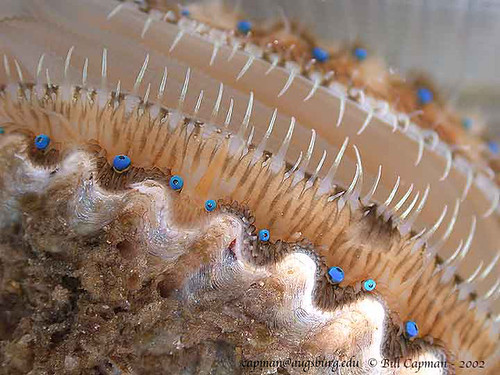
This photo, for example, has been published on the cover of the British Journal of Ophthalmology, on the cover of a conservation organization's annual report, in a French nature magazine, in Science magazine, in several museums, in several other publications, and last week the author of an upcoming book on endangered New England marine life contacted me to ask about using it in his book, and possibly on the cover. I've been getting requests for using this photo at least every 6 months ever since I used is as the subject of a "Biology Photo of the Month" story on our department's web site.

1385270567_9ced514d52.jpg


This was shot with a Nikon 995 point and shoot. This was considered a pretty nice digital camera at the time (it was before DSLR's got "inexpensive"), but it is only a 3 megapixel camera!

All the photos in this article were also taken with the same camera:

http://www.reefkeeping.com/issues/2002-06/bcap/feature/index.php

and the close crop of the Bryopsis in that article was used in this book: http://www.oup.com/us/catalog/general/subject/LifeSciences/Ecology/?view=usa&ci=9780195175097

Not bad for a point and shoot.

And this shot was taken with a 2 megapixel (!!!) HP point and shoot:

damselfly-nicesideview.jpg

(and a larger view: http://www.augsburg.edu/home/biology/photoofmonth/damselfly-largephoto.jpg )


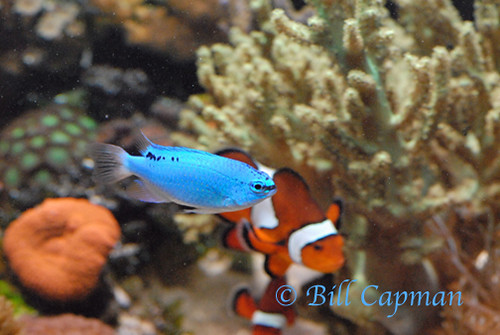
However, the "its the photographer, not the camera" line (so often said in Flickr forums that I want to scream sometimes when I read it) is not totally true (as I know the other Nikon DSLR shooters above me in this thread certainly know). DSLRs sometimes do give you far superior results. For example, I never managed to get anywhere near decent color rendition of a damselfish before taking this shot with the D200:

2395240883_53f3bb320e.jpg


Most point and shoots will not allow you to use off-camera flash to get the cool lighting that made this photo nice:

2395240879_46c59da65d_o.jpg


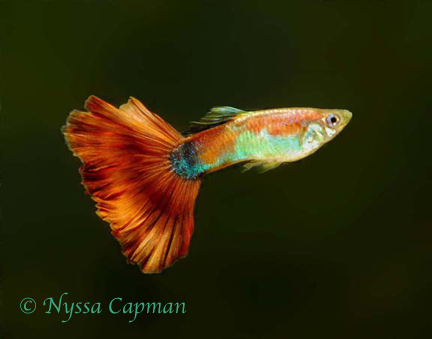
And a shot like this would be darn difficult to get with a point and shoot, for several reasons (including focal length, focusing speed, and the delay that most point and shoots have after pressing the shutter before actually taking shots):

1370956992_08e97cb298_b.jpg

Actually, a shot like this is difficult even with a fast DSLR and good lens. I can hardly imagine getting this with a point and shoot unless you were really lucky.


And there are lots of other things that you can do with a DSLR that you either cannot do, or cannot do very easily with a point and shoot. Manual focus, manual exposure, rapid manipulation of depth of field on the fly, rapid changes to misc camera settings, rapid changes to different auto exposure modes, changing custom white balance settings on the fly, switching to auto bracketing on the fly, and all sorts of other things like this that can matter to you a lot when out in the field shooting birds or insects, or shooting action in a theatrical production, etc, etc. etc. A lot of these things are SO much easier with a DSLR.


This being said though, the image quality you can get from today's point and shoot cameras (even some of the tiny ones that fit in your pocket!) is truly amazing!
 
Last edited:
Liars. You NEEEED a macro lens to take good shots.

The difference between your first two is depth of field. I'm still trying to understand exactly how to manipulate that. It seems most DSLR people like extremely small DOF with a lot of "bokeh". This is a bit frustrating to deal with because sometimes I want a large DOF like the first P&S pic.
 
Thanks for the compliments on the Birdnest. Do remember that the shot was taken under ATI Blue+ and Procolor only so the pink is pretty extreme. Under full spectrum it's not as brilliant.

The first two pictures of the Acan were both taken at f/8. The major difference as Bill has said is that using the DSLR allowed me to take the picture at 1/60 of a second vs. 1/5 of a second on the P&S.

I purposely didn't make the above comparison for trying to take pictures of fish because their fast movement demands faster shutter speeds. With the point and shoot, under the same lighting, I'm unable to stop the fish AND have enough light. With the DSLR, this isn't a problem.

Also, Bill congrats on having that pictures published! It really is amazing what can be done with Point & Shoot cameras today if you have the proper subject.
 
Liars. You NEEEED a macro lens to take good shots.

The difference between your first two is depth of field. I'm still trying to understand exactly how to manipulate that. It seems most DSLR people like extremely small DOF with a lot of "bokeh". This is a bit frustrating to deal with because sometimes I want a large DOF like the first P&S pic.

All you need to do to increase depth of field is to use a smaller aperture (meaning a larger f-stop - e.g. f/22 or f/32 rather than f/2.8). If you reduce the aperture size, you need to compensate somehow to make up for the smaller amount of light getting through the smaller aperture. To compensate, use a slower shutter speed and/or higher ISO and/or have brighter lighting. That is all there is to the depth of field issue.

OK, in addition to f/stop, depth of field is also affected by focal length and distance to your subject, but at a given focal length at a given distance, you manipulate depth of field by changing the aperture. That is all there is to it. Take some test shots of a ruler or yardstick or something (e.g. with the ruler pointing away from you). Make sure you are fairly close to what you are focusing on (which reduces depth of field, making for a better test). Change your aperture gradually, working through from your widest aperture (smallest f/stop number) to your smallest aperture (largest f/stop number). Compare your photos. I think you'll be impressed by the results.

If you do a google search for "depth of field calculator" you can find a number of web sites that will be helpful. For example: http://www.dofmaster.com/dofjs.html
 
Last edited:
OH, and regarding the macro lens issue....

Yes, the photographer has very limited ability to compensate for not having a macro lens. So, it IS partly the camera, not just the photographer.

That being said though, many point and shoots have very good close focusing ability, and this is something to check before you buy a camera. The Nikon 995 point and shoot, for example, gives a similar field of view as a 1:1 macro lens on a 35mm camera (though you have to be extremely close to your subject to get this level of magnification with the 995).

The original post does make a good point though, which is that if you know what you are doing, you can get some stunning results even with cheap point and shoots. In fact, if a person does NOT know what he or she is doing, results might sometimes be better with the point and shoot than with a DSLR. If a person knew very little about how cameras work, it would be very easy for that person to accidentally make adjustments to the settings of my DSLR that would make it impossible for that person to take a decent photo, but if you do know even just the basics of photography (especially the interplay between aperture, shutter speed, and ISO, and how all of this all works with different focal lengths, then a DSLR gives you MUCH more flexibility and control than most point and shoots.
 
Last edited:
So in the above picture of the acan, while both shots were taken at f/8 - the P&S was further away from the subject @ 28mm (cropped) and the picture with the DSLR was taken using a 105mm (uncropped) creating less depth of field even though the same f-stop was used.
 
Sensor sizes probably differ though between the point and shoot and the DSLR, so those focal lengths would not be directly comparable. But yes, if you get farther away from your subject normally you will have more of that subject in focus.
 

Users who are viewing this thread

Back
Top