


Banner image

Zim's 200g build (1 Viewer)

Why don't you do a large skin for the front held up with counter sunk magnets, and have bifold doors on that front panel.

I am a big fan of Bifold doors because they give you easy access to the sump and if you need to do some big work, then you can pull the whole panel off. Which I guess wouldn't be too often once your tanks stable.

Don't know if this is feasible or not... Just thinking out loud.


Sent from my iPhone using Tapatalk
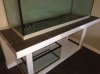
 
If I understand you correctly, your idea is to do a complete face frame that is held on with magnets. Which I really like. Bi-fold doors wouldn't be a necessity with that idea either because if a major job is in order, just take the complete front off.

Great idea, I'm definitely now considering it. Thanks for the feedback!
 
I've done a fair amount of looking to answer this question, with no solid answers.

How tall do you need to make an overflow? How deep should the teeth go? Teeth spacing/gaps?

I'm planning on doing an acrylic overflow on a glass tank. I've read that you need to have a 3/8 thick bead of silicone when doing so. Is that true? I'm planning on the herbie method overflow since I only have 3 return/drain holes.
Since it's a rimless tank, should the height and/or teeth be lower? I already have some 3/8" cast acrylic from A1. I'm able to use our CNC router at work to do all this, so it's just a matter of coming up with the design.

Thanks in in advance for any feedback.
 
You can make it as short as you like in a rimless tank, you don't care where the water level ends up being as you are not trying to get it to hide behind the rim.

What you can't do is make it too tall, because the teeth and drain etc will limit how quickly water will skim off the surface and fill the overflow. This will likely raise the water level slightly above the bottom/middle of the teeth. If you have the overflow too tall, it will then put the water level close to the top of your rimless tank and when you go to reach in, splish splash.

My advice, go look at a few display tanks of similar size, observe the overflows (one or two) and the number of teeth and then try to get a feel for how far above the bottom of the teeth the water level is. Go from there.

Also, I think your pump size will have a little bit to do with how far above the bottom of the teeth the water level settles. Stronger the pump/faster the draining, the higher the water level as it is 'dammed up' more by the teeth etc.

I don't think it is an exact science.

For me, I'd put it lower. I have a rimless nano, sucks putting my hand in there, no rim to keep it in. I have heard people with full sized rimless tanks say the same thing...

As for spacing and teeth gap, I'd copy whatever you see on the stock overflows.
 
I'm not sure why all uploaded pics have turned into links...

Anyways the the last one is of my mock up of the overflow box. Complete with removable cover to stop algae growth. The bottom of the teeth are 2.125 below the the tank's top edge. With a return line hole on the right. Box is 12" wide and 6" deep for reference.

Ill take all critiquing possible to make it better.
 
Last edited:
IME: I personally would not want the top cover of the overflow flush with the rimless tank. Not sure it that's what your intending or just the mock up looks like.

Just throwing worst case scenerios out there, what if say a sheet of nori gets pulled of the clip by tanks ( happens frequently to me ) covers some teeth to slow water flow down or teeth width slowly get smaller from coraline algae etc. and can no longer keep up with the return pump flow. You really want some room above the overflow that if worst case the teeth can't keep up that the water can go up and over the overflow walls and not spill on the floor. I'd give 1/2" myself. I would not make the cover water tight for that same reason.
 
Last edited:
Made some more progress the last couple weeks.

Trimmed out the bar edge. Last minute decision was to not do a drawer (couldn't find drawer slides that I liked) so I just did a flip down cubby area for testing equipment, towel, remotes, etc.
I did install bulkheads and plumbed in a gate valve on the main drain as well as 2 ball valves on the return and emergency lines. Then to unions. I'm going get a custom sump made, but until then it'll be a 40B with filter socks, some weers and a skimmer. Pretty basic for now. My return pump should be here next week. Went with a jebao DCT6000. Bought 2 for redundancy. But, I was able to start doing a second leak test with tap water. Filled 1/4 way on Sunday. And it looks like I need to either replace or tighten 1 bulkhead. Slight drip from the middle one. Everything else is showing no leaks. So, drain, fix, start the process again.


Sent from my iPhone using Tapatalk
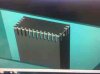
 
I gave my leaking bulkhead ne last attempt and turned it another 1/4 turn and waited. It has since sealed up and hasn't had a dripped at all. Then I filled it up to half full and it and everything is still dry. I'll let it sit til this weekend and then up to normal water level.
 
Late night, Big headache....

So, I knew buying an older tank came with risks. I really wanted a 72" tank, rimless, and heavy glass.

I found it, in perfect condition, no scratches. Water tested it in my garage for almost 3 months.

Built a heavy duty stand that was laser straight and level. Foamed between tank and stand. Water tested in place at 1/4,1/2, 3/4, then full. All at one week intervals.
It got filled the last 1/4 on Sunday morning.

It blew out the left rear vertical silicone seam at 12:45 last night......

Had the draining method already in place, so even with that substantial leak, I got most drained vs on the floor.

Now what to do???
I kind of built the stand to the tank.

Is there a way to completely take it apart then rebuild as if we're a new tank?

Help on this aspect would be great, this is outside my skill set


Sent from my iPhone using Tapatalk
 

Users who are viewing this thread

Back
Top