

Banner image

Aquaculture Happy Dance - 23rd species spawned! (1 Viewer)

I am up to date on the lightening project. Hardly anything changes, so if one reads it once a month it more than sufficient.

While I know about your setup being "in the works" it's really not too tough to setup a 20ga for a few months.

I talk about a risky environment only because you do in your blog. Nipped fins caused you to pull it from fully interacting.

You've had the clown for almost a year now, right? While I know I don't have he first hand breeding experience you do, it really seems that an expert should be able to figure the sex of a fish out by now-especially after having successfully spawned 23 species.

While there's a risk in trying to pair, you could crag your tank and kill it in the process too. There's a risk in everything. As my grandpa says "sh!t or get off the pot" :).

As I assumed that weight see traits in the F1, you are assuming we won't. There's only one way to know for sure, and that's through trying.

I'll try expanding a bit tomorrow when I'm on a computer instead of my phone.

I hope you don't mind me busting your chops and playing devils advocate too much:) While I can understand your end goals and respect that, I guess that I just think that in he interim you could be making some forward progress testing theories to shorten the "product lifecycle" once your "perfect setup" is finally done. (which at this point beat case scenario would be to see lightening eggs in a year from now, nearly two gets after brought to captivity)
 
Last edited:
I am up to date on the lightening project. Hardly anything changes, so if one reads it once a month it more than sufficient.

Ouch! (but admittedly there is some truth there!)

While I know about your setup being "in the works" it's really not too tough to setup a 20ga for a few months.

I spent the last couple months working on building a better larval rearing system..so that's where the money all went. So actually, it IS tough, and the tank "in the works" has been in the works for a few months now and admittedly, it is a good portion my fault because I was asking for something non-stock for the benefit and security of the fish.

I talk about a risky environment only because you do in your blog. Nipped fins caused you to pull it from fully interacting.

Not exactly accurate. Nipped fins, caused by the Bristletail Files through the eggcrate, caused me to think that Finrot had started. SPLIT fins, cause by aggression, caused me to end the first date. Yes, you have a point in that i don't know if it was the Centropyge argi or the large Labrador Maroon that caused the splits. Truly it is a tossup. But I think you're underestimating the risks inherent with pairing maroons in general, especially this maroon at this particular size.

You've had the clown for almost a year now, right?

No, I think 8 months.

While I know I don't have he first hand breeding experience you do, it really seems that an expert should be able to figure the sex of a fish out by now-especially after having successfully spawned 23 species.

Ah, but that's where you make a huge assumption that no one with my level of experience should make. The "experts" in fact disagree on what sex this fish is. First off, you simply cannot tell on a clownfish just by looking. Second, the Lightning Maroon is at a size where it could be EITHER a functional male or female. It goes so far that experienced breeders even disagree with the behaviors recording as this fish interacted with first the original PNG female and later with the Labrador Maroon (where some see submissive behavior, others see aggression). So while I personally believe the Lightning Maroon is a male, I lack the proof. I want it to be male, but quite literally, it could be female. If it IS female, or even was when I got it, treating it as a male could end this grand experiment very quickly and painfully.

HOWEVER, there has been one documented proven case of a sex "reversal" in clownfish (Amphiprion bicinctus). There are several documented examples of bidirectional hermaphrodism in Dottybacks as well. I've even DONE IT with Dottybacks twice now. The kicker in the dottybacks is simple...it takes significantly longer for a fish in the terminal sex to revert to the primary sex.

SO, to take this knowledge and extrapolate it...IF in fact the Lightning was a female, there is still an outside chance that given AMPLE time, it could theoretically be reverted to a male. No way to prove that it would have happened, but the longer it is allowed to safely interact with extremely larger female maroons, and the more patient I am, the better the chances are for success. I don't wish to get into the whole 'keep it male vs. female' debate here again, because that's a decision I've made as the breeder entrusted with this fish. Once I let it go female, it's not like I can "take it back".

While there's a risk in trying to pair, you could crag your tank and kill it in the process too. There's a risk in everything. As my grandpa says "sh!t or get off the pot" :).

But as your grandpa also probably knew, good things take time, and you can't rush mother nature.

As I assumed that weight see traits in the F1, you are assuming we won't. There's only one way to know for sure, and that's through trying.

Ah, but again, you're writing as if I'm "not trying"...as if this fish is in complete isolation. In fact it is not, it is paired, albeit through eggcrate, with a large White Stripe Maroon. I also have a pair of White Stripes sold to me as a spawning pair. Neither of these large, 100% guaranteeably female Maroons, are spawning at this time. Up until earlier this week, there wasn't a single maroon in the house known to be spawning. You're writing as if I've had a spawning gold stripe for months...while I may have, I was not aware of it.

You also write as if I can just swap the Lightning Maroon into the place of the small PNG male, which honestly, I am not so sure would be a good idea period. You also fail to consider that any time you move or split up a spawning pair of clownfish, it will take an abstract amount of time, typically measured in months, before they resume spawning. You also don't know that the Lightning Maroon is substantially larger than the PNG maroon in the spawning pair, and that this larger size would decrease the acceptance rate of the Lighting as a male, assuming it IS a male.

No, the better or best pairing at the moment, if I wanted "quick" results, would be to take the Lighting Maroon and pair it with the small PNG Maroon that is now spawning. That's 100% an option that's on the table, and that's the very reason I make sure to keep some of the PNG Maroons male even if it meant pairing them with simply whatever large Maroons I could get my hands on.

I hope you don't mind me busting your chops and playing devils advocate too much:) While I can understand your end goals and respect that, I guess that I just think that in he interim you could be making some forward progress testing theories to shorten the "product lifecycle" once your "perfect setup" is finally done. (which at this point beat case scenario would be to see lightening eggs in a year from now, nearly two gets after brought to captivity)

Again, drawing some assumptions and while I get the analogy, the use of the term "product lifecycle" irks me. You're kinda grasping at straws to assume that spawning in a new setup is going to take yet another year, but even if it does, so what? For all you know, the Labrador maroon could drop a nest tomorrow. On the flipside, I could move the Lightning Maroon in with the PNG male and wait 5 years before something happens. MANY clownfish take YEARS to spawn for the first time. However, Clownfish lifespans are measured in DECADES, with Percs documented living up to 30 years in the wild. That gives me some time to take my time to do this "right", and to me, the fastest path to spawnings, sacrificing everything else, is not the goal of this project.

FWIW,

Matt
 
Last edited:
Yes - http://www.youtube.com/watch?v=nFMZxnPeREE

Showed up with a few nicked fins after an hour or two and was returned to the basket. Don't know if the split fins were from the Lab Maroon or the Centropyge angelfish in the tank. Then was getting fins nipped THROUGH the basket, which I figured out was actually the Bristletail Filefish.


Yes, if I didn't say so already before.


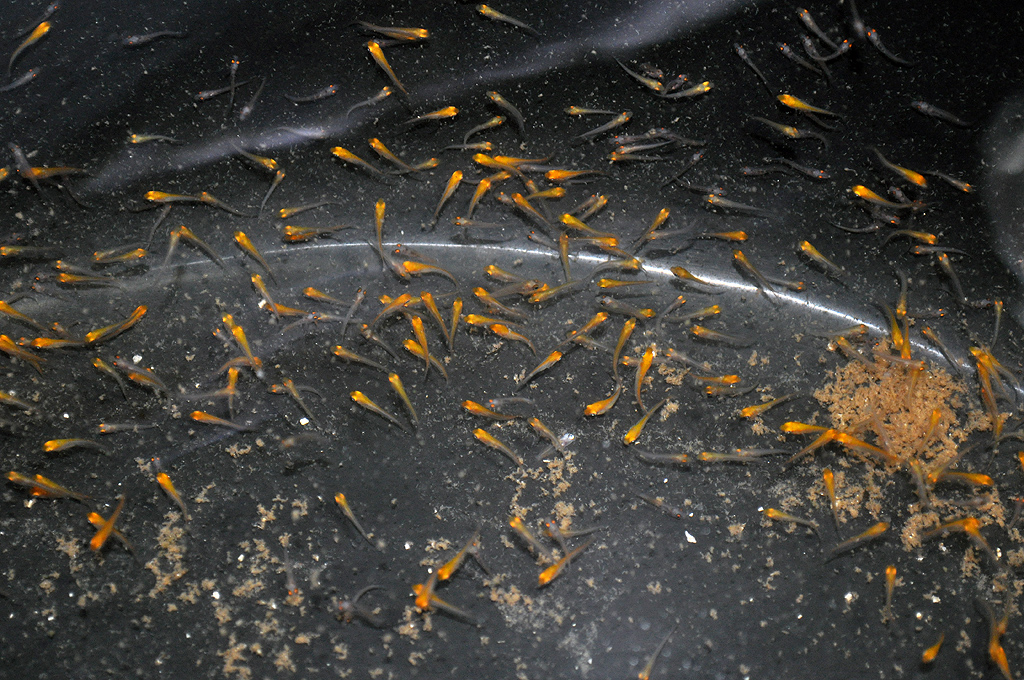
Which Dottybacks, these?

DSC_0323_Ps_flavivertex_10-26-2010.jpg

What kind of Dottybacks are those?????
 
Maybe I'm just confused on the whole thing then. I thought your goal was to breed this fish, and bring more to the public eventually. Then I re-read most of your blog last night, and am more confused than ever (party due to the length).

Without going into much in-depth explainations, give me your "30-second elevator-pitch" on this project, why you, and your goals as concerned to the Lightening Maroon Clownfish.
 
What kind of Dottybacks are those?????

Reeflover, Those are newly settled Pseudochromis flavivertex - Red Sea Sunrise Dottybacks.

I thought your goal was to breed this fish, and bring more to the public eventually.

In simple terms, that is the goal. But the goal is not to do this at the expense or dispensing of any other good breeding practices.

Without going into much in-depth explainations, give me your "30-second elevator-pitch" on this project, why you, and your goals as concerned to the Lightening Maroon Clownfish.

Sure, OK, I'll humor this request although the phrase "30-second elevator-pitch" suggests you're somehow interviewing me for the job...sorry to tell you I already was "interviewed" and beat everyone else out for it yet I didn't even know it at the time. Still, perhaps you missed the "about" page which kinda sums it all up? - http://www.lightning-maroon-clownfish.com/?page_id=2

Goals, from the link above:

1. Keep the Lightning Maroon alive in captivity. (will continue to succeed at this until I fail)

2. Pair the PNG Lighting Maroon with the most appropriate mate available (at this time, since there is NOT a female PNG Maroon in my hands, it is paired with a female generic white stripe maroon, because as explained in the blog, there are benefits to keeping the Lightning Maroon male IF it IS a viable male).

3. Attempt to spawn and rear the F1 offspring from the Lightning Maroon. (in the first half of this phase now)

4. Distribute the F1 offspring to any and every marine fish breeder interested in working with the offspring

5. Undertaking this project in the spirit of full disclosure and transparency to the point of accepting public failure if that became a reality. (always doing this)

6. Using the attention this project will garner to share meaningful discussions on topics directly and indirectly related to the project. (doing this as well as things come up)


Why Me?


So here's the 30 second, hit my credentials answer although I'd never normally answer this way because it will sound cocky to say the least. Why me? because I'm the 2009 MASNA Aquarist of the Year, specifically for my contributions to the captive breeding of marine fish including my worldwide first, the captive spawning and rearing of the "doomed" Orange Spotted or Harlequin Filefish, Oxymonacanthus longirostris. I am the first, and still the only person to have done so. Maroon Clowns are a cakewalk by comparison.

So let me not be shallow, and instead let me answer in-depth by framing the "why me" question in relation to those project goals I laid out.

1. Keep the Lightning Maroon alive in captivity - easier said than done. I'm going to quote Kevin Kohen on this one from a comment he said to me at the last open house - "I'm surprised you kept it alive...those are tough when they come in". The OTHER Lightning Maroon, from 2008, I've been told my multiple sources is in a freezer somewhere. 23 years of SW experience including years at retail and doing imports means I have way more experience handling new fish than most hobbyists.

2. Pair the PNG Lighting Maroon with the most appropriate mate available - First and foremost, I am a strong believer in maintaining geographical populations distinct in captive breeding. A lot of hobbyists and breeders don't get it. What this means is that a lot of our captive bred strains are actually somewhat bastardized hybrids and hodgepodges, or at least are now questionable in that regard. You can no longer trust the species integrity of captive bred A. rubrocinctus or A. akallopsisos unless the breeder has full records going back to the wild import INCLUDING collection locations..I'll elaborate further if I must. Suffice it to say, being an outspoken critic of designer clowns, being that I had zero interest in the fish until it was learned that this was a wild fish with a known collection location, must have set me apart from some breeders who would have just paired it with any random mature female maroon. The emphasis for ME is to perpetuate a clean PNG line first...that way even if none of the offspring show Lightning Characteristics, I am still breeding really nice PNG Maroons. There is also the off chance that another PNG Maroon from the same area may have a genetic component needed...more likely than anywhere else at the moment, so again, staying PNG is important to increasing the success of actually producing more Lightning Maroons. Right now, the sub goal of keeping the fish male is winning out over the sub goal of mating to a PNG fish, but at least I'm staying within the same color form of the species vs. going to one that some people consider a different species altogether. So, in the end, the views I hold are cultivated from my experiences as a breeder, including running an African Cichlid hatchery, and I can only assume that these views are valued by the people who selected me to be the person to breed the fish.

3. Attempt to spawn and rear the F1 offspring from the Lightning Maroon - First off, I can tell you that most of the highest bidders weren't even breeders, they were fish collectors. There would be 0 chance of more Lightning Maroons coming from those potential buyers. So the sellers already made a decision to a breeder over a collector to provide for the potential of more Lightnings in the future. So that's why a breeder, by why me? Arguably there are better breeders...those who've already spawned Maroons and those who've already fixed a strain from a wild variation (in thinking this through, really being critical, I believe only ORA has actually done so, with the Picasso Percula). Still, my relative disdain for "man made strains" hasn't prevented me from learning about them...and I assume my understanding of the man-made fish didn't hurt my chances of being selected to work with this fish.

4. Distribute the F1 offspring to any and every marine fish breeder interested in working with the offspring - no commercial breeder is going to release fish that might be carrying the genetics, let alone make it a point to do so. Since I'm not commercial, I can take F1 offspring and sell them off, as solid "PNG Maroons" provided I've used the right mate. This is especially important if no F1 offspring show Lightning characteristics. By using the methodology of "open source breeding", I can leverage ANY interested breeders to house as many pairs of F1 offspring to see if some random F1 pairing produces Lightning in the F2 generation. And provided I got the offspring from a mating of 2 PNG maroons, those F1 sibling pairs will still be producing nice F2 PNG Maroons. A nice little side note for SEASMART perhaps is that all those F1 and F2 Maroons will also be suitable for outcrossing with PNG Maroons from SEASMART. All of this is far more than any commercial breeder could ever dedicate to securing the mutation (assuming it even IS genetic), and thus, this methodology is far more likely to succeed than putting this fish into a commercial setting.

5. Undertaking this project in the spirit of full disclosure and transparency to the point of accepting public failure if that became a reality. - let me be blunt - I don't think ANY other breeder, especially most that were in a real position to accept this fish, would've said ANYTHING about the project upon taking the fish. There would be no http://www.thelightningproject.com, that's for sure. There wouldn't be a breeder sharing the progress, or lack thereof, let alone answering questions about the project. No, more likely you'd hear NOTHING of the project unless or until it produced more Lightning Maroons, and then, that would probably be all you'd hear...there was success. That contributes nothing to the general hobby or knowledge-base.

6. Using the attention this project will garner to share meaningful discussions on topics directly and indirectly related to the project - admittedly this hasn't happened to the extent I wanted, but it's tough to get busy people to take time out to contribute freely to a project like this. Still, I look for the opportunities to discuss issues / topics related to the events of the project as they unfold. Just look at the recent discussion about the name Premnas epigramma, which occasionally floats around. I actually took the time to dig into that and write about it, only because I now have a "hybrid" pair of Maroons spawning. So...meaningful discussion...well, not really discussion since there weren't any related comments by users, but I'm sure you see the point.

So there ya go. Feel free to ask for any more clarifications or pose any counterpoints.

Matt
 
Matt - I appreciate you taking the time to lay out your thoughts a bit more clearly here. While I can see your end goal and agree with it, I guess as a heavily schooled scientist, I see far more opportunity in gathering intel along the way to your eventual goal - rather than waiting and waiting and hoping for something to pan out in the end (in terms of selecting a mate/tank/etc). It seems as though you are being orders of magnitude more patient with learning more about this fish in your attempt to keep the bloodlines a pure PNG as possible.

In simple terms, that is the goal. But the goal is not to do this at the expense or dispensing of any other good breeding practices.

I still am going to stick with my guns and propose there is still very useful information one could learn about this fish through very minor experimentation that would not deviate from your strict ideals. I know you are going to come back with a comment about 'this is not a fish to experiment with' - but with adequate care and time invested (something you claim in your previous comment to have more of to dedicate to this than other breeders), much knowledge could be gained about genetic traits of another species of clownfish.

Still, perhaps you missed the "about" page which kinda sums it all up?

Perhaps you missed in my last post how I re-read your entire blog yesterday? No, I did not miss this page. What you failed to read from my last post was that throughout your blog the true purpose of this fish did not - to the reader - seem as clear as you may think it is. Throughout your progression, it seems the attitude has shifted from pairing and breeding, to using this fish more as a platform to advance your agenda of "pure" strains of clownfish above that of your goal #3 - Attempt to spawn and rear the F1 offspring from the Lightning Maroon.


6. Using the attention this project will garner to share meaningful discussions on topics directly and indirectly related to the project - admittedly this hasn't happened to the extent I wanted, but it's tough to get busy people to take time out to contribute freely to a project like this. Still, I look for the opportunities to discuss issues / topics related to the events of the project as they unfold. Just look at the recent discussion about the name Premnas epigramma, which occasionally floats around. I actually took the time to dig into that and write about it, only because I now have a "hybrid" pair of Maroons spawning. So...meaningful discussion...well, not really discussion since there weren't any related comments by users, but I'm sure you see the point.

Actually, I fail to see the point. A discussion needs a response. Without a response it becomes a lecture. If you enjoyed the Premnas epigramma topic you speak of, then in essence you enjoy the lecture, not the discussion.

I know we've gone back and forth on this project a bit over the past, and I'm finally going to be straight with you on why this previous hasn't happened for this project, or for your other "example" that you gave. A truly productive conversation can only happen if both sides are willing to actually listen to what the other has to say. In my last post, I put myself in your shoes. I re-read your blog, tried to understand what you are going through and working with. The process that can be slow of pairing and mating clownfish, the criticism from people like me when you lay it all out there for the public to see....BUT, when you come back at comments with what appears to be condescending, arrogant, demeaning attitudes as you continually do to anyone who has opinions other than your own, you simply cannot generate any kind of constructive debate. I did not attempt to "interview" you as you so kindly pointed out that you already had done and won, I simply wanted a SIMPLE explanation - something you also have difficulty doing. I know for a fact that I am not the only one frustrated with your keen ability to throw others under the bus while touting your own abilities and beliefs. A "discussion" with you is like PETA holding a "discussion" on the techniques of raising beef cattle! They are quite obviously heavily skewed in one direction and their opinions will not change no matter what you say. I tried giving you the benefit of the doubt and have you give a quick blanket statement on what this project means, and it's future goals, but instead you chose again to take cheap shots throughout. Many more people would actually listen to what you have to say if the attitude was one of accepting constructive criticism and thinking critically about what others have to say rather than immediately put them down.

I'm not attempting in any way to make enemies or have you or anyone dislike me over this (though you likely do by now), but I just wanted to call it like I see it, and bring some things to light that others may not.

I acknowledge that you have a vast amount of knowledge when it comes to breeding fish. I'm honestly glad that the fish went to a breeder and not a collector. I'm glad that it's up here in the upper midwest (hometown pride). I'm glad that you've put it all out there on the 'net for us all to see what's happening. I agree with your end goal.

What we obviously fail to agree on is the road you are taking to get there. What I dislike is the method by which you interact with anyone who voices opinions or holds ideals dissimilar to yours.
 
Last edited:
I guess as a heavily schooled scientist, I see far more opportunity in gathering intel along the way to your eventual goal

Correct me if I'm wrong, but I believe the "intel" you're referring to whether mating this fish to an unrelated form will produce more Lightning Maroons in the F1 generation?

rather than waiting and waiting and hoping for something to pan out in the end (in terms of selecting a mate/tank/etc).

"waiting and hoping for something to pan out in the end" = typical clownfish breeding. Many species take years to pair up and spawn for the first time. Took my WC Onyx Percs 1.5 years, took my CB Black Ocellaris 4 years. I continue to get the impression that a lack of quick results is one of your main criticisms, but you're not acknowledging the simple truth that clownfish breeding is not a rushed affair to start with. I feel like I'm starting to repeat myself here which is simply frustrating. Let me reiterate that even simply moving an actively producing pair to another tank in the same room can shut them down for months.

So, let's just say I was going to swap out the little PNG Maroon now for the Lightning Maroon. Best case scenario, the female is spawning in weeks. Worst case scenario, she kills him. Meanwhile, how do we not know that the female White Stripe Maroon he's already with isn't going to start spawning 2 weeks from now? We don't. We have NO WAY of knowing. You are advocating making a risky choice, and a choice to move "further" from an ideal mate rather than "closer", based purely on speculation and a desire for "quick results". You're basically insisting I ask "any question" rather than asking the "right question".

I've already explained the tank situation as well, so for you to bring it up again seems like you're just not listening. It's a little insulting at this point. This fish was in a tank by itself initially, and eventually it was moved OUT of that tank for its own safety as the disease issues with the female did not abate. This fish remains in an eggcrate cage for its own safety, and even in a new tank, I may STILL opt to keep it in the cage to prevent a large female from killing it. Eggcrate is not a barrier to fish sex...the fish can visually interact and fertilize a spawn. I know it works with clowns because I've asked people who've done it (i.e. Joe Lichtenbert) and I've done it with Cichlids that might otherwise kill their mates.

I'm sorry if it sounds "arrogant or condescending" but which one of us is the one with more breeding experience here? It seems as if I present the facts, and the facts are ignored or dismissed.

It seems as though you are being orders of magnitude more patient with learning more about this fish in your attempt to keep the bloodlines a pure PNG as possible.

Again, I feel like I already answered this earlier. Your comment implies that I don't have this fish paired up - I "do", and it's not with a PNG Maroon either. Up until this last week, NONE of the mature Female Maroons in my basement were spawning (I have 3 adults on hand, the GSM female that spawned, the Labrador WS and another WS female from an pair sold to me as actively spawning). How do you propose I "speed up this process"???! This IS THE PACE we're at, and frankly, it's entirely realistic for clownfish.

I still am going to stick with my guns and propose there is still very useful information one could learn about this fish through very minor experimentation that would not deviate from your strict ideals. I know you are going to come back with a comment about 'this is not a fish to experiment with' - but with adequate care and time invested (something you claim in your previous comment to have more of to dedicate to this than other breeders)...much knowledge could be gained about genetic traits of another species of clownfish.

#1. What useful information are you thinking of?
#2. What types of experiments?
#3. Ironically, there has been some "experimentation" on the subject of "what's the sex of this fish"...i.e. http://www.lightning-maroon-clownfish.com/?p=479 - note the "control" (2 presumed males) and the experiment (a proposed pairing). Note the outcomes of each introduction.
#4. So...what additional "adequate care and time investment" should I be making that I'm not?
#5. Have you stopped to weigh the risks of these experiments? Is the information gathered worth the possible risks to the overall project?

Perhaps you missed in my last post how I re-read your entire blog yesterday? No, I did not miss this page. What you failed to read from my last post was that throughout your blog the true purpose of this fish did not - to the reader - seem as clear as you may think it is. Throughout your progression, it seems the attitude has shifted from pairing and breeding, to using this fish more as a platform to advance your agenda of "pure" strains of clownfish above that of your goal #3 - Attempt to spawn and rear the F1 offspring from the Lightning Maroon.

Ha...geez...quick to condemn and use semi-derogatory terminology to attack something you don't understand (i.e. implying that I have a "agenda of pure strains of clownfish" as if it's a bad thing - afterall, we don't typically refer to someone having an "agenda" as a positive ;) ).

So, let me spell it out - when there's nothing to report on re: breeding because we are at the "wait and see" phase of a clownfish breeding project, the posts got light. What would you expect? There's really not much to say on the subject of breeding until I a) opt to change the situation / arrangement or b) something changes without my manipulations. And, as per my earlier comments...what if it takes years for the Lightning Maroon to spawn with ANY fish? In the meantime, I've posted a few updates about various topics, including yes, talking about hybridizing most recently because the Maroon pair that spawned ISN'T an appropriate pair, especially if we're breeding from a conservation and species preservation standpoint. That's not an "agenda", that's the facts at hand.

BUT, when you come back at comments with what appears to be condescending, arrogant, demeaning attitudes as you continually do to anyone who has opinions other than your own, you simply cannot generate any kind of constructive debate.

I have to chuckle, because you get what you give. Gladly will point it out for you:

Jab #1 - I am up to date on the lightening project. Hardly anything changes, so if one reads it once a month it more than sufficient.

Jab #2 - it really seems that an expert should be able to figure the sex of a fish out by now-especially after having successfully spawned 23 species.

I did not attempt to "interview" you as you so kindly pointed out that you already had done and won, I simply wanted a SIMPLE explanation - something you also have difficulty doing.

That would be at least Jab #3.

I know for a fact that I am not the only one frustrated with your keen ability to throw others under the bus while touting your own abilities and beliefs.

Who have I thrown under the bus, and for what?

Need I remind you, I myself say I am "not an expert"

A "discussion" with you is like PETA holding a "discussion" on the techniques of raising beef cattle!

Jab #4?

I tried giving you the benefit of the doubt and have you give a quick blanket statement on what this project means, and it's future goals, but instead you chose again to take cheap shots throughout.

Would love to see what you think are "cheap shots".

Many more people would actually listen to what you have to say if the attitude was one of accepting constructive criticism and thinking critically about what others have to say rather than immediately put them down.

How did I "put you down"?

I'm not attempting in any way to make enemies or have you or anyone dislike me over this (though you likely do by now), but I just wanted to call it like I see it, and bring some things to light that others may not.

And if I may call it like I see it, it seems primarily that you're just disappointed I'm not doing it your way, and it does seem that even though you initially concede your lack of expertise, you're not willing to concede that I have a more intimate knowledge and understanding. You're not willing to listen to the information I present because you feel it's condescending to provide the facts, theories and thoughts behind the project? I feel very "attacked" for "not doing this "right"" from your viewpoint, yet you're coming with a viewpoint that is not nearly as informed. I apologize if filling in the facts and pointing out the weaknesses in your ideas comes across as condescending and arrogant, because last time I checked, that IS a constructive dialog...you postulate, I respond, and we move forward, not in circles as it seems this has become.

I'm honestly glad that the fish went to a breeder and not a collector. I'm glad that it's up here in the upper midwest (hometown pride). I'm glad that you've put it all out there on the 'net for us all to see what's happening. I agree with your end goal.

Honestly I suggested many other breeders than myself for this fish. I did not have any desire for this fish when talking with the vendors about who should get this fish and my opinion on what should be done with it. It's here because the vendors thought it best that it go to me, and it's here because your fellow TCMAS members helped me scrape the funds together to make it happen.

What we obviously fail to agree on is the road you are taking to get there. What I dislike is the method by which you interact with anyone who voices opinions or holds ideals dissimilar to yours.

What I think you dislike is that I don't agree with your opinions or proposed ideas, and I provided concrete facts, knowledge and experience to explain why. Heck, more than once I acknowledged the validity of a viewpoint but explained why it's not something I did or would do, and again why. I haven't seen much anything in the way of "facts" or "experiences" coming along with your arguments. Back your stuff up, otherwise it's not going to carry weight.

No, it seems you've decided to make this into a gripe on my online personality, calling me arrogant and condescending and claiming I've put you down. No, I went and looked. The closest I ever found to a "put down" was to say you weren't understanding something (i.e. how the tank is set up currently)...but how could you? I don't think I've ever actually really posted full tank shots so people could see it, so once again, just stating a fact, not putting you down. I'm sorry you made the discussion personal.

Matt
 
huh.... i just found 10 dollars in my coat.... sweet....

all i can honestly say is however it is done and however long it takes to get the desired result that is best for our hobby is the right way to go...

matt- i think you are thinking about this more as the hobbiest here... a very concious hobbiest, but a hobbiest none the less... the interactions ive had with you have been great, and i look forward to picking your brain on a few things down the road...

mr curley q- ur a scientist.. you have a totally different thought process...

neither of you are wrong... your both right... from a scientific standpoint there are things matt could be doing to where we learn a few things about this fish and "why" it came to be the way it is.. doesnt mean your right... but it also doesnt mean he is right... he was awarded this fish because he will do whats best for this fish... but since he was awarded it, he gets to choose how it is done... right or wrong is in the eye of the beholder...

the result i wish to see, is baby lightning clowns... does it matter to me personally if they are 100 png maroons... honestly, no... but i respect the fact thats how its going to be done.... so im gunna go get a mellow yellow out of my fridge... sit back.... wrinkle up some newspaper and figure out how im going to aquascape my tank when it gets here...

cheers


i want to add, you both want the same result, you both deep down want to see lightning babies... and thats all that matters....

matt i should of said your a breeder.. its just like with any breeder they are not going to put a mate they may feel is insuficent just to see of certain traits are passed along... they will wait for the right mate...


curley- i think you may be more interested in seeing if this certain trait is something that can be passed on... just like we all do...

much love to you both... and with that said... IM RIGHT!!!!!!
 
Last edited:
Well put Wireefman. I also can see both points of view, while holding my own opinion.

Matt seems to be confident that he will succeed with what he is attempting (a geographically pure line of wild type lightning Maroons). However, we don't even know if such a thing exists, and this is only the second sport (mutation) to occur in the wild population). My concern is that the lightning 'gene' if it exists (and it probably does, whether simple or epistatic), may be lost forever (just like the other one in the freezer), if the F1s are distributed for breeding. I suppose the existing one could be cloned if we wanted all genetically identical individuals, however, the more homozygous the strain, the weaker the individuals in the population are, and the more likely they are not to thrive. In most 'scientific' circles the goal is to out-cross mutations so as to establish hybird vigor, and fix the mutation in a population free from other undesirable genetic traits that weaken the population through inbreeding and limited genetic variability.

I think there is room for both schools of thought. Matt seems to be a pure-ist, and that is admirable. Matt you will probable have to try to find a lot of individual maroons from the same location in order to establish a population with the greatest diversity possible to avoid a weakened line.

However, I would like to see the trait fixed as soon as possible, before it can be lost (individuals can be lost for no good reason even under the best of care, ie like defective heater), and I would volunteer to work with the F1s, rather than see them be put down.

I know no one asked me......but that's my 2 cents worth.:violin:
 
Last edited:
Matt seems to be confident that he will succeed with what he is attempting (a geographically pure line of wild type lightning Maroons).

Arguably, one of the most important assets in breeding success is the simply will and determination, and positive thinking.

However, we don't even know if such a thing exists, and this is only the second sport (mutation) to occur in the wild population).

The original Picasso Perc was collected in the Solomon Islands. Others have been collected there as well, along other color forms. It is possible that other Picassos that have come in wild have come in from other areas. The thing about location it is independent of the possible Lightning Mutation.

Here's a hypothetical example. Amphiprion pacificus vs. A. akallopsisos. Up until this year, both species were considered A. akallopsisos. Let's say some "zebra striped" morph of A. akallopisos was found in Africa. Let's say there weren't any other "zebra striped" ones around, nor any others from Africa handy, so the breeder used some "Akallopsisos" from the Pacific for breeding. Well, turns out that what actually was created is no longer A. akallopisos, nor is it A. pacificus...it's a hybrid. The breeder certainly didn't know it at the time, but these fish likely would've entered the trade as A. akallopisos "Zebra" in the meantime. 10 years later, we could find a "Zebra Striped" A. pacificus somewhere...what then?

To a lot of people, the answer is "who cares"? I get that. But it works both ways...what does it matter to those same people if the breeder took the extra precautions to ensure geographical populations aren't mixed in a breeding program? It doesn't matter either way to the average person, it matters to your fellow breeders, and it matters in terms of species conservation and preservation.

My point is that it's dangerous to dismiss geographical populations as a factor in a breeding program because we collectively may or may not have a full understanding of what they really represent. I.e. my Vanuatu Pink Skunks that are orange...are they someday going to be a separate species or subspecies? Hard to say, but I know they're both from Vanuatu, so if this population ever gets split off, we can follow that split appropriately. I also know that if Vanuatu ever lost it's Pink Skunks, I have "the pink skunk clown" from Vanuatu, and thus, in theory, there is some foundation by which the natural form could be restored.

As it circles back to your initial statements, the actual concern is to ensure a "geographically pure line" of Maroon Clowns from PNG. Not all the PNG Maroon's are lightnings, but at least 2 have been. This alone suggests a slight advantage, very very slight, that a PNG mate might carry a latent gene that, let's say a Gold Stripe from Sumatra, is less likely to have, going solely on the known occurrences of Lightning Maroons in Sumatra. The trait of being a PNG Maroon, and having the Lightning "mutation" are independent. It just so happens that so far, to date, the mutation has only occured in clownfish from PNG. If a lightning maroon showed up in the Solomon Islands, well, then we could blur the geographic lines to go Lighting to Lightning for example...but what if later on the SI Maroon was split off from the PNG maroon for some unforeseen reason? Then what?

In the end, given all the assets available to me, the goal of maintaining PNG bloodlines and Lightning Genetics is possible to achieve. However, as you should understand, the PNG goal is currently being sacrificed in preference of the Lightning trait and the other goal of keeping the Lightning Maroon male, by virtue of the fact that I have no PNG Females and thus have paired the Lighting with the location-unknown Labrador Maroon, which is at least a white stripe...the same color form as the standard PNG Maroons.

My concern is that the lightning 'gene' if it exists (and it probably does, whether simple or epistatic), may be lost forever (just like the other one in the freezer), if the F1s are distributed for breeding.

How does distributing F1 offspring cause the gene to be lost?

I think it's quite the opposite...by making the F1 offspring available (assuming none outwardly show the Lightning Trait) I am leveraging more resources than I, or even a large breeder like ORA, could throw at the project. Imagine if every hobbyist breeder got a pair of F1 offspring and started breeding. How many pairs could be set up in the F1 generation? 50? 100? 1000? I can't even set up 2 or 3 pairs here right now..so by shear numbers, there's a greater chance at SOMEONE getting the right combination by distributing F1 babies.

I suppose the existing one could be cloned if we wanted all genetically identical individuals, however, the more homozygous the strain, the weaker the individuals in the population are, and the more likely they are not to thrive.

Can we clone fish yet? What's the cost to do so? If we had 2 cloned fish, breeding them to each other well...would that work out just fine or be a catastrophe? Who knows. BUT, since it would be sexual reproduction, in theory there would still be variation in how the gametes come together.

In most 'scientific' circles the goal is to out-cross mutations so as to establish hybird vigor, and fix the mutation in a population free from other undesirable genetic traits that weaken the population through inbreeding and limited genetic variability.

But first you must establish the desired trait too. Fish can be line bred to F6 without issues. It offers plenty of opportunity to line breed and back cross before the NEED to outcross arises.

That said, there's a reason I don't just have 1 or 2 PNG Maroons here, but 4 + the Lightning Maroon. I already have 2 juvies in a "pairing" situation in the hopes of establishing another breeding pair of PNG Maroons...this will provide a lot of outcrossing opportunities right away, if it doesn't actually provide me with a female PNG Maroon to mate the Lightning Maroon to.

I think there is room for both schools of thought. Matt seems to be a pure-ist, and that is admirable. Matt you will probable have to try to find a lot of individual maroons from the same location in order to establish a population with the greatest diversity possible to avoid a weakened line.

LOL, yup...read above. I've had 2 PNG Maroons die...the large female, and the "Morse Code". The other 4 juveniles are here. I've asked SEASMART for a few more PNG Maroons...that's an "in progress" thing as well.

However, I would like to see the trait fixed as soon as possible, before it can be lost (individuals can be lost for no good reason even under the best of care), and I would volunteer to work with the F1s, rather than see them be put down.

OK, but let's get back to this massive push to pair the Lightning Maroon up with a sexually active GSM. The bottom line is that the proponents of such a move simply cannot understand the issues with that, outside of the "hybrid" nature of such a pairing. If you did understand the issues, you'd be much less likely to support the decision or think this was the right course of action.

The move to pair up the Lightning Maroon with the spawning Gold Stripe has no better chances at getting babies any sooner than leaving it as is. In fact, it is possible that, so far, spawning could juts as easily happen sooner with the fish it's been paired with for a few months vs. now introducing it to a NEW mate.

Meanwhile, pairing it with the GSM ALSO introduces new risks, and takes us away from the project goals on the whole, sacrificing everything else solely for the hope of maybe getting babies sooner. I truly believe that the spawning GSM is a Red Herring here. To pursue this is to go off the path on a perceived shortcut that likely isn't, led astray by some assumptions that don't hold up against the general wisdoms of clownfish breeding.
 
Matt, you definitely know what you are talking about, and I understand completely where you are coming from. I may not agree 100%, but I do understand and respect your position, and since they are your clowns, you get to decide. You are more of a zoologist, concerned with naturally occurring subspecies and varieties. I think of it more as a geneticist, more interested in the gene and phenotype. You are also an amazingly gifted fish breeder.

On that 3rd quote from me, I meant to say "if the F1s are 'not' distributed". That was a typing error. But you did pick up that the statement was not correct.

I understand that you want to keep the strain pure, just in case for example some day a taxonomist decided to consider this a separate species or if it needs to be reintroduced into the wild. But let me challenge you with this thought. That once you captively breed any organism, you change the selection pressures on that organism and start the process of genetic drift. One could argue that after several generation of captive breeding you no longer have the same variety as in the wild, because you have selected for different traits than those necessary to survive in their wild habitat. Certainly, a greater than 50% survival rate of young to maturity is not expected in the wild. By captive breeding you are selecting for individuals that can survive and thrive and pass on their genes in captivity, which do not necessarily equate to survival in their home environment. So there will be genetic drift no matter what you do. And if you breed your pure strain in captivity long enough, they will become a different variety and then species from the wild-type PNG lightning maroon, and there is nothing you or anyone else can do to stop that, other than continuing to outcross to wild-caught maroons. I realize I am verbalizing an extreme position, and playing devils advocate. But some purist could out purist your views, and suggest this very thing (and in a very real way they would have a point as well).

As for me, I would welcome an opportunity to fix the gene and discover how it is passed by working with some of the F1s. So I hope you will not put them all down, and maybe allow me to work with the gene itself, rather than with this particular variety of maroon clown. I believe there is room for both. You are working with and trying to preserve a specific variety of maroon clown, which is the goal that floats your boat, and is a worthy and admirable goal.

And there are ways to clone fish that is relatively easy. They can do it from the eggs, so you would have to let yours become female to do it.
 
You are more of a zoologist, concerned with naturally occurring subspecies and varieties. I think of it more as a geneticist, more interested in the gene and phenotype.

Ah, but per my earlier example, concerns of genetics are also tied to the geography, i.e. my example of A. pacificus vs. A. akallopisos. The species distinction was confirmed through genetic analysis, but the geographical distance / barriers is just already present. It could be that the "Lightning" genetics is something tied to a specific geographical location, just like the "gold stripe" maroon is, as far as the literature suggests, only occuring in Sumatra. Why are there no gold stripes in PNG or the Solomons?


...or if it needs to be reintroduced into the wild. But let me challenge you with this thought. That once you captively breed any organism, you change the selection pressures on that organism and start the process of genetic drift. One could argue that after several generation of captive breeding you no longer have the same variety as in the wild, because you have selected for different traits than those necessary to survive in their wild habitat.

A very valid concern, one that's already showing itself in species survival programs like the LVSSP (Lake Victoria Species Survival Program). There are examples of "plastic morphology", where fish in the wild develope traits that their captive counterparts don't, as well as species that developer different morphology in captivity over a few generations (i.e. teeth changing form). What we don't know, and possibly can't know, is whether these changes are due to genetics or due to environmental influences, or both.

Certainly, a greater than 50% survival rate of young to maturity is not expected in the wild. By captive breeding you are selecting for individuals that can survive and thrive and pass on their genes in captivity, which do not necessarily equate to survival in their home environment. So there will be genetic drift no matter what you do.

All possibly true. This is why breeders look to outcross back to wild fish, and why we need WILD FISH as broodstock in breeding programs. This is also why most hobbyists should opt for captive produced fish, reducing the need for wild fish, which in theory will extend our access to wild fish longer that it might other wise be (assuming that we may one day lose access to wild fish for any number of reasons).

And if you breed your pure strain in captivity long enough, they will become a different variety and then species from the wild-type PNG lightning maroon, and there is nothing you or anyone else can do to stop that, other than continuing to outcross to wild-caught maroons.

Which is precisely what responsible breeders try to do.

I realize I am verbalizing an extreme position, and playing devils advocate. But some purist could out purist your views, and suggest this very thing (and in a very real way they would have a point as well).

No, you're not taking an extreme position at all, you're talking about solid breeding practices, especially when conservation / preservation comes into play. Where problems crop up is when people see the "it's going to happen no matter what you do, you can't stop it", it then makes some people say "well then why bother at all?" and becomes a free pass to just do whatever they want.

As for me, I would welcome an opportunity to fix the gene and discover how it is passed by working with some of the F1s. So I hope you will not put them all down, and maybe allow me to work with the gene itself, rather than with this particular variety of maroon clown.

Perhaps you've misunderstood what is currently mating with what? The fish I intended to put down, IF I were to raise them, are the offspring of a PNG White Stripe Maroon with a Sumatran Gold Stripe Maroon. There is probably 0.0000000% chance that there's lightning genetics in there. The only thing that could be learned from this cross is how the White Stripe vs. Gold Stripe genetics interact, that's it. From my standpoint, such a cross potential to be very damaging to the integrity of White Stripe and Gold Stripe Maroons in captivity, especially to Gold Stripes, so even if i were to raise the offspring, I would be doing so SOLELY to get some experience raising Premnas biaculeatus, and that's it. Thus, they would get put down afterwards. I cannot stop someone else from setting up a WS X GS pair and doing the tinkering and rearing, but I won't be a party to it nor will I sell of what I perceive to be "potentially problematic fish" for the hobby in general. To do so would be irresponsible.

A good example of how easily things could go awry...all it takes is for one person to mistake Sanjay's Black Photon Percularis as an Onyx Perc, and then to mate it with an Onyx Perc and sell of the babies as Onyx Percs. Hopefully that won't happen, and it won't be directly Sanjay's doing either...he's not passing off a hybrid as a regular fish. Still, while Sanjay contributed to our collective wisdom by showing everyone how the Black Ocellaris stripe genetics interplayed with an Onyx Percula's stripe genetics (offspring stripe up faster than true percs), the release of these fish into the hobby does up the anti that such a breeding blunder could be made by someone else down the line.

Now, back to the currently spawning babies - CurlyQ believes I should be pairing the Lightning Maroon with the GSM. But I'm not doing it, so rest assured I'm not destroying any Lightning Maroon offspring.

I believe there is room for both. You are working with and trying to preserve a specific variety of maroon clown, which is the goal that floats your boat, and is a worthy and admirable goal.

Indeed, I have already made such a compromise as I outlined above. This fish is not currently paired with a PNG Maroon afterall.

And there are ways to clone fish that is relatively easy. They can do it from the eggs, so you would have to let yours become female to do it.

And you'd have to get eggs as well, which means she'd have to spawn. But hey, have a link on the cloning? By all means, if it could be done affordably, then there's an argument to be made for letting Mr. Lightning become a She... (and frankly, I am starting to lean in that direction anyway...but that's another discussion altogether).
 
A good example of how easily things could go awry...all it takes is for one person to mistake Sanjay's Black Photon Percularis as an Onyx Perc, and then to mate it with an Onyx Perc and sell of the babies as Onyx Percs. Hopefully that won't happen, and it won't be directly Sanjay's doing either...he's not passing off a hybrid as a regular fish. Still, while Sanjay contributed to our collective wisdom by showing everyone how the Black Ocellaris stripe genetics interplayed with an Onyx Percula's stripe genetics (offspring stripe up faster than true percs), the release of these fish into the hobby does up the anti that such a breeding blunder could be made by someone else down the line
ha i was just reading about thoes and someone had said... arnt thoes onyx percs?.... litterally right before i saw this.... funny.... didnt sanjay sell thoes? nm he still has momma and pappa
as you were....
 
Last edited:
Kinda proves my point with little else left to argue LOL.

The freshwater hobby is full of these types of issues. I think what irks me more is that people look at the breeding of marine fish and think it's somehow "new", and thus demand, while stomping their feet, "who's to say what's right, let alone who are YOU to say what's right?!" To the first, I'm gonna point to all these other interest groups, i.e. our freshwater brethren, so that we don't make the same mistakes they have. We do not need to reinvent the wheel here, we should learn from the wisdom presented in these other groups. Otherwise, we're putting the blinders on...

BTW, I used the world anti when I meant ante ;)
 
BTW, actually Sanjay lost one of the fish in the pair, and if I'm remembering correctly, he back-crossed one of the Black Photons to the surviving mate? Admittedly I haven't followed the story lately, but I do know he had a second generation that weren't "Black Photons" due to the backcross. Maybe he re-paired the fish again and is back to producing Black Photons?
 
I can tell where this is heading ....regulations, just what we need, more government in our lives. Akc is a perfect example .Power corrupts
 
And you'd have to get eggs as well, which means she'd have to spawn. But hey, have a link on the cloning? By all means, if it could be done affordably, then there's an argument to be made for letting Mr. Lightning become a She... (and frankly, I am starting to lean in that direction anyway...but that's another discussion altogether).

Here is a link for you: https://wiki.zfin.org/display/prot/Overview+Of+Methods+For+Parthenogenesis
The pressure method is the one that is done at private fish hatcheries. Don't know that it's ever been tried on clown fish, but might be worth a shot.

I should have read more carefully what you and Curlyque were discussing. I was under the impress that you had breed the PNG lightning male to a non-PNG WS female, and were going to destroy the F1 cross just because the female was not PNG. I apologise and should have read more carefully. I was of the opinion that the F1 from such a cross should not be destroyed simply because the female was non-PNG, because the lightning gene was so rare. Yes, I agree with your reasons for terminating the F1 cross you were speaking of (not that you need or seek my approval in the first place :gay1:)
 
Here is a link for you: https://wiki.zfin.org/display/prot/Overview+Of+Methods+For+Parthenogenesis
The pressure method is the one that is done at private fish hatcheries. Don't know that it's ever been tried on clown fish, but might be worth a shot.

Interesting to say the least. I noticed at first they were making haploid offspring, which probably would be infertile, but then I noticed the heat or pressure to induce the embryos to become diploid. Interestingly, that's a real short way to find out if there's a genetic basis or not...if all the clones come up normally barred..well..then we'd know it was an environmental thing ;)

I should have read more carefully what you and Curlyque were discussing. I was under the impress that you had breed the PNG lightning male to a non-PNG WS female, and were going to destroy the F1 cross just because the female was not PNG.

Ha, no...that's the current pairing I have going, and those offspring would be reared and distributed if I got them. I'm OK with that because there are tons of "generic" "White Stripe" Maroons in the hobby and breeding programs, so to take a generic "White Stripe" and mate it with another "White Stripe" from PNG, makes more "generic" "White Stripes". In fact, SEASMART has been shipping fish for a while...while my particular "Labrador" White Stripe is probably not a PNG Maroon, there are certainly PNG Maroons out there just known as White Stripes. That's the sad part about collection location info...once its lost it generally cannot be "restored". The bottom line, I won't be doing any "damage" to the "generic" captive bred WS Maroons through this mating. Of course, that presumes that the "generic" white stripes in captivity are the same species as the PNG White Stripe, which we probably can presume them to be. The "new" clownfish species that have come up recently (Amphiprion barberi, A. pacificus) were visually distinct on some level (even A. pacificus made it into a book as an aberrant A. peridariaon rather than the normally given name of A. akallopisos) and were geographically isolated from other species. PNG is not particularly isolated parsay, and thus there probably is some gene flow from other WS Maroon populations, and there is nothing distinctive about a PNG Maroon. Long story short, it is probably unlikely that would have a different species in the PNG WS Maroon. It's still possible, but since we don't know what makes up generic WS Maroons anyway, it is certainly possible that were there more than one species of "White Striped Maroon", they could've been muddled already in the CB lines. Long story short, introducing the PNG bloodline just really can't make things much worse for CB WS Maroons....they're already at the lowest common denominator.

I apologise and should have read more carefully. I was of the opinion that the F1 from such a cross should not be destroyed simply because the female was non-PNG, because the lightning gene was so rare.

No need for the apology, and I do clearly agree that WS X WS = WS, so if that's how I slip the Lightning genetics into a F1, that's what I'm going to do. PNG Genetics would be preferable of course.
 

Users who are viewing this thread

Back
Top