
Navigation
Install the app
How to install the app on iOS
Follow along with the video below to see how to install our site as a web app on your home screen.

Note: This feature currently requires accessing the site using the built-in Safari browser.
More options

You are using an out of date browser. It may not display this or other websites correctly.
You should upgrade or use an alternative browser.
You should upgrade or use an alternative browser.
cypho's 36" DIY reef (1 Viewer)
- Thread starter cypho
- Start date

jlanger
@thatfishcookieguy
Lifetime Member
Event Committee
Meeting Host 2020
Meeting Host 2021
Meeting Host 2022
I was nervous that this post was going to be "Now I have only one fish left in the tank; Cypho."
When I first started this hobby in the '90s, the dottybacks were one group of fishes I really liked. I started out with the Diadema Dottyback and then picked up a Red Sea Neon Dottyback (much nicer looking than the CB ones available nowadays); which both had calm demeanors. So I then added an Aussie Multicolor Dottyback to another tank, and that's when I learned how aggressive the species can be! Holy!
Try squinting; worked for me.
When I first started this hobby in the '90s, the dottybacks were one group of fishes I really liked. I started out with the Diadema Dottyback and then picked up a Red Sea Neon Dottyback (much nicer looking than the CB ones available nowadays); which both had calm demeanors. So I then added an Aussie Multicolor Dottyback to another tank, and that's when I learned how aggressive the species can be! Holy!
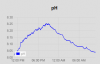
The graph however needs some work. I need to smooth out all of that jitter.
Try squinting; worked for me.
My old cypho never gave anyone any grief. But I always assumed he was CB ( I got it from Inland Aquatics in the late 90's ) which may partially explain the difference. I'm hoping that he learns to get along with everyone eventually. Or at least everyone else learns how to stay out of his way. He doesn't seem to go out of his way looking for a fight.I was nervous that this post was going to be "Now I have only one fish left in the tank; Cypho."
When I first started this hobby in the '90s, the dottybacks were one group of fishes I really liked. I started out with the Diadema Dottyback and then picked up a Red Sea Neon Dottyback (much nicer looking than the CB ones available nowadays); which both had calm demeanors. So I then added an Aussie Multicolor Dottyback to another tank, and that's when I learned how aggressive the species can be! Holy!
Try squinting; worked for me.
How about a simple moving average filter.
Attachments
Last edited:
I made some upgrades to my RO filter a few weeks ago.
I have been running the DI stage empty. I decided that was a waste of a perfectly good canister so I reconfigured it to function as a 2nd carbon pre-filter stage.
I also added 2 pressure gauges: one between the sediment filter and the first carbon block. It turns out I have good water pressure. This one reads 80 PSI. And the 2nd pressure gauge measures the pressure in the RO storage tank. This one was lower than I expected (relative to the first one). The auto shutoff valve lets the pressure drop to around 30 PSI before activating and shuts down at around 55 PSI.
I read somewhere that the permeate pump can function as a shutoff valve for the RO filter. So I tried removing the shutoff valve to see what would happen. It does work. The wastewater line is pinched off when the tank pressure matches the input pressure of 80 PSI.
The higher tank pressure is really nice, but there was one big downside. It exposed a number of problems with my plumbing. Leaks all over. After replacing or tightening all of the leaky fittings I thought all was good.
I was wrong. It turns out the solenoid valve I am using to control ATO is directional. And I had it installed backwards. It was able to withstand 55PSI of backpressure, but with 80PSI pushing the wrong way on the solenoid valve, the water was able to push right through the solenoid valve into the tank.
Fortunately, I planned ahead for solenoid valve failure, and installed a float valve as a backup. So all that happened was the water in the sump went up an inch or two. The backup worked so well, it took me a few weeks to notice anything was wrong. I only noticed the problem because of a slight leak between the solenoid valve and the float valve which shouldn't ever be exposed to high pressure.
I flipped the solenoid valve around and it is back to working as designed.
The only real long term downside to the new configuration is that as soon as the storage tank pressure drops at all the RO filter kicks back into gear. So the each cycle is much shorter than it was before. I wish there was some way to prevent the RO filter from turning on until the pressure dropped 5-10PSI while still being able to bring the tank up to full pressure.
Which brings me to my next big DIY electronics project. After I finish building out the main aquarium controller/monitor, I'm going to make a smart RO controller/monitor with pressure gauges, flow meters, TDS meters, and solenoid valves in every potentially useful position.
I have been running the DI stage empty. I decided that was a waste of a perfectly good canister so I reconfigured it to function as a 2nd carbon pre-filter stage.
I also added 2 pressure gauges: one between the sediment filter and the first carbon block. It turns out I have good water pressure. This one reads 80 PSI. And the 2nd pressure gauge measures the pressure in the RO storage tank. This one was lower than I expected (relative to the first one). The auto shutoff valve lets the pressure drop to around 30 PSI before activating and shuts down at around 55 PSI.
I read somewhere that the permeate pump can function as a shutoff valve for the RO filter. So I tried removing the shutoff valve to see what would happen. It does work. The wastewater line is pinched off when the tank pressure matches the input pressure of 80 PSI.
The higher tank pressure is really nice, but there was one big downside. It exposed a number of problems with my plumbing. Leaks all over. After replacing or tightening all of the leaky fittings I thought all was good.
I was wrong. It turns out the solenoid valve I am using to control ATO is directional. And I had it installed backwards. It was able to withstand 55PSI of backpressure, but with 80PSI pushing the wrong way on the solenoid valve, the water was able to push right through the solenoid valve into the tank.
Fortunately, I planned ahead for solenoid valve failure, and installed a float valve as a backup. So all that happened was the water in the sump went up an inch or two. The backup worked so well, it took me a few weeks to notice anything was wrong. I only noticed the problem because of a slight leak between the solenoid valve and the float valve which shouldn't ever be exposed to high pressure.
I flipped the solenoid valve around and it is back to working as designed.
The only real long term downside to the new configuration is that as soon as the storage tank pressure drops at all the RO filter kicks back into gear. So the each cycle is much shorter than it was before. I wish there was some way to prevent the RO filter from turning on until the pressure dropped 5-10PSI while still being able to bring the tank up to full pressure.
Which brings me to my next big DIY electronics project. After I finish building out the main aquarium controller/monitor, I'm going to make a smart RO controller/monitor with pressure gauges, flow meters, TDS meters, and solenoid valves in every potentially useful position.
Last edited:
jlanger
@thatfishcookieguy
Lifetime Member
Event Committee
Meeting Host 2020
Meeting Host 2021
Meeting Host 2022
Come on, William!!!
Get a hobby! I think a good distraction from your DIY projects will make the rest of us seem somewhat useful!
When you say you want to build a smart RO controller/ monitor, are you implying that you're going to have remote access and alerts sent to your phone/tablet?
Get a hobby! I think a good distraction from your DIY projects will make the rest of us seem somewhat useful!
When you say you want to build a smart RO controller/ monitor, are you implying that you're going to have remote access and alerts sent to your phone/tablet?
For sensors I'm thinking:
For control:
For the smarts:
But all of this is a long way out, I still have plenty of ideas left to implement on the main aquarium controller.
- Flowmeters on the input, permeate, and wastewater lines to monitor water efficiency, to detect leaks ( if in != out, there must be a leak ), and to keep track of how much water has gone through the filters.
- Pressure and TDS sensors between each stage to detect clogged or exhausted filters
- Pressure sensors to compare tank and input pressure to turn it on/off
- A temperature probe just because I'm curious how the temperature varies from summer to winter and how that affects efficiency.
- And a leak/water detector on the floor.
For control:
- A solenoid on the input to turn the whole thing on/off
- A solenoid flush valve
- A solenoid on the output to dump the first permeate down the drain until the TDS creep water has been flushed out (as determined by the output TDS meter)
For the smarts:
- Web based control panel showing all sorts of stats
- Customizable on/off pressures
- Email alerts when sensors detect a clogged/exhausted filter or when the quantity of water that has passed through the filter is sufficient to warrant replacement.
- Email alert for unusually bad (or good) efficiency (not sure what would cause this, but it can't be good)
- Email alert for very low tank pressure (indicates possible leak)
- Email alert for leak
But all of this is a long way out, I still have plenty of ideas left to implement on the main aquarium controller.
Last edited:
I've recently experienced a new form of rapid acro death. Instead of the tissue flaking/peeling off, the tissue on two colonies literally dissolved - I see a cloud of acro colored dust float away at each wave surge. Fortunately I only lost two frags, and oddly, the acros that aren't dieing are showing some of the best color/growth that I've seen since I first started having problems.
In my last few tanks, everything grew so quickly that even with 100% of the evaporation topped off with kalkwasser, my Ca was always lower than I wanted. So for this tank I went with 2-part since it is not evaporation limited. But instead of corals growing, they are dieing. I'm wondering if the kalkwasser's pH boosting powers were more important to my previous success than I realized.
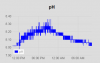
Now that I have a pH probe, I can see that the pH swings is from 8.27 during the day down to 8.04 at night. This does not sound too awful, but I have no idea what the pH was like on previous tanks. So with no better suspects I'm going to see if smoothing the pH swing has any impact.
Today I setup a BRS 50ml/min dosing pump (thanks David) to add kalkwasser. For a starting point, I've programmed the controller so that when the pH is below 8.18, the kalk pump will run for 1 minute every 10 minutes. Realistically it won't run during the day, so it will max out at ~1 gal/day. I have no idea if that will be enough to keep the pH up during the night, but I did not want to leave open the possibility that it could run 24/7 and I know that 2 gal/day won't hurt anything.
I could have the controller keep track of how much kalkwasser is used and adjust the 2-part doses accordingly, but I suspect this would be over thinking things.
At least the clams are all doing well.

In my last few tanks, everything grew so quickly that even with 100% of the evaporation topped off with kalkwasser, my Ca was always lower than I wanted. So for this tank I went with 2-part since it is not evaporation limited. But instead of corals growing, they are dieing. I'm wondering if the kalkwasser's pH boosting powers were more important to my previous success than I realized.
Now that I have a pH probe, I can see that the pH swings is from 8.27 during the day down to 8.04 at night. This does not sound too awful, but I have no idea what the pH was like on previous tanks. So with no better suspects I'm going to see if smoothing the pH swing has any impact.
Today I setup a BRS 50ml/min dosing pump (thanks David) to add kalkwasser. For a starting point, I've programmed the controller so that when the pH is below 8.18, the kalk pump will run for 1 minute every 10 minutes. Realistically it won't run during the day, so it will max out at ~1 gal/day. I have no idea if that will be enough to keep the pH up during the night, but I did not want to leave open the possibility that it could run 24/7 and I know that 2 gal/day won't hurt anything.
I could have the controller keep track of how much kalkwasser is used and adjust the 2-part doses accordingly, but I suspect this would be over thinking things.
At least the clams are all doing well.
Attachments

Last edited:
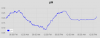
I need to create some logs to see how often the kalk is kicking on/off but that worked a lot better than I expected for a first try. All night the pH hovered right at 8.18.
Only time will tell if this will have a positive impact on the coral, but I like the way it looks on the screen.
I also added some noise filtering on the data collection side which also worked surprisingly well. The line looks much smoother now.

Only time will tell if this will have a positive impact on the coral, but I like the way it looks on the screen.
I also added some noise filtering on the data collection side which also worked surprisingly well. The line looks much smoother now.
Attachments
Last edited:

Assuming it's full strength kalkwasser ( 2 teaspoons per gallon ) stirred only once. It is roughtly equal to 80mil of BRS 2 part per gallon of Kalkwasser. So you can kinda use that as an Idea how to reduce your 2 part from your current settings. If you went through say half a gallon last night then reduce your daily 2 part by 40mil.
Like we talked about having a low end point will vary how much is added per day and may not be quite a predictable as it would if you only used a high point for redundancy.
My experiences, its very unlikely an 8.04 - 8.27 is the root cause. You really don't start seeing negative effects of low pH until your hitting 7.7s as the morning low. This is assuming that ALK levels are at or above 7dkh.
For calcification, bi-carbonate is easier for corals to uptake. As pH rises the alk ratio shifts from bi-carbonate to more carbonate. So for growth ( and again this is tecnically true but perhaps in reality if won't have a noticalbe effect ) the sweet spot is around 8.1. The fact that your low was 8.04 was still in the sweet spot for calcification.
Like we talked about having a low end point will vary how much is added per day and may not be quite a predictable as it would if you only used a high point for redundancy.
My experiences, its very unlikely an 8.04 - 8.27 is the root cause. You really don't start seeing negative effects of low pH until your hitting 7.7s as the morning low. This is assuming that ALK levels are at or above 7dkh.
For calcification, bi-carbonate is easier for corals to uptake. As pH rises the alk ratio shifts from bi-carbonate to more carbonate. So for growth ( and again this is tecnically true but perhaps in reality if won't have a noticalbe effect ) the sweet spot is around 8.1. The fact that your low was 8.04 was still in the sweet spot for calcification.
Last edited:
Assuming it's full strength kalkwasser ( 2 teaspoons per gallon ) stirred only once. It is roughtly equal to 80mil of BRS 2 part per gallon of Kalkwasser. So you can kinda use that as an Idea how to reduce your 2 part from your current settings. If you went through say half a gallon last night then reduce your daily 2 part by 40mil.
Thanks, I haven't checked how much I used last night, that bit of math will help if I decide to get super-precise with my dosing.
Yes, the amount of Kalk will vary for day to day, but It would be easy (with your formula above) to have the controller automatically adjust the 2-part dosing routine based on much Kalk was added the night before.Like we talked about having a low end point will vary how much is added per day and may not be quite a predictable as it would if you only used a high point for redundancy.
My experiences, its very unlikely an 8.04 - 8.27 is the root cause. You really don't start seeing negative effects of low pH until your hitting 7.7s as the morning low. This is assuming that ALK levels are at or above 7dkh.
For calcification, bi-carbonate is easier for corals to uptake. As pH rises the alk ratio shifts from bi-carbonate to more carbonate. So for growth ( and again this is tecnically true but perhaps in reality if won't have a noticalbe effect ) the sweet spot is around 8.1. The fact that your low was 8.04 was still in the sweet spot for calcification.
I agree that the pH values seem like they should be fine. But at the moment it's the best theory I have to explain the coral deaths. Ruling this out will at least force me to come up with another theory.
jlanger
@thatfishcookieguy
Lifetime Member
Event Committee
Meeting Host 2020
Meeting Host 2021
Meeting Host 2022
It seems the mysterious acro blight has hit a number of us members over the past few months; and all for various reasons.
Your case seems really bizarre with the dissolving tissue. I wonder if it's similar to the RTN that other's have experienced, but without your strong waves causing the bursts of tissue.
When my torts crashed, they looked fine one day and the next day there was nothing left but a bare white skeleton; all of the tissue just gone. This was due to me adding the soda ash solution directly into the display, so a strong pH shift could definitely be on the list of culprits.
Hopefully you'll get this all figured out.
Clams look awesome, William!
Your case seems really bizarre with the dissolving tissue. I wonder if it's similar to the RTN that other's have experienced, but without your strong waves causing the bursts of tissue.
When my torts crashed, they looked fine one day and the next day there was nothing left but a bare white skeleton; all of the tissue just gone. This was due to me adding the soda ash solution directly into the display, so a strong pH shift could definitely be on the list of culprits.
Hopefully you'll get this all figured out.
At least the clams are all doing well.
Clams look awesome, William!
Last edited:
I'm really starting to think that low pH might have been a contributing factor to my sps issues. The stove was on all day on Saturday and the pH never got up past 8.20. Even with the kalk at night, 2 days later the high is only 2.22.
I am now starting to see some burnt tips, probably from high alkalinity (200 ppm according to hanna checker). But burnt tips are still an improvement, nothing's worse than RTN.
___________
On Saturday evening I pulled the two Swalesi Basslets out to give them a break from cypho-aggression and the male clown to give him a break from the female. All 3 were starting to look a bit worse for the wear and looked like they might be on the verge of catching ich. I'll let them chill out in a 10 gallon tank for a few more days and they reintroduce them when I add the new fish I just ordered.
___________
I just received an alert from Blue Zoo that they had a female Cypho purpurascens in stock. Of course I can't possibly pass that up. I added a pictus blenny and a queen conch to fill up the box.
Anyone care to bet on which of four possible futures will come true?
I am now starting to see some burnt tips, probably from high alkalinity (200 ppm according to hanna checker). But burnt tips are still an improvement, nothing's worse than RTN.
___________
On Saturday evening I pulled the two Swalesi Basslets out to give them a break from cypho-aggression and the male clown to give him a break from the female. All 3 were starting to look a bit worse for the wear and looked like they might be on the verge of catching ich. I'll let them chill out in a 10 gallon tank for a few more days and they reintroduce them when I add the new fish I just ordered.
___________
I just received an alert from Blue Zoo that they had a female Cypho purpurascens in stock. Of course I can't possibly pass that up. I added a pictus blenny and a queen conch to fill up the box.
Anyone care to bet on which of four possible futures will come true?
- The two cyphos team up to hunt and destroy the basslets.
- The two cyphos are so busy trying to kill each other they forget about the basslets.
- The two cyphos fall in love and are just so happy they forget about the basslets.
- One cypho kills the other and then goes back to harassing the basslets (and of course it will be the less pretty female that survives)
Last edited:

#4 is usually pretty common with aggressive fish.

jlanger
@thatfishcookieguy
Lifetime Member
Event Committee
Meeting Host 2020
Meeting Host 2021
Meeting Host 2022
#5. Pictus Blenny trumps all other fish and the dottybacks find a new home!!!
But , then again, I'm biased towards the blenny; and you're the other way.
I would agree that the fourth option is the most likely outcome.
If you're able to set up a smaller tank with a divider to test the reactions of the two dottybacks, that could tell you if the two fish would be compatible. I think that trying to acclimate the two of them amongst other fish might be more stressful than helpful.
But , then again, I'm biased towards the blenny; and you're the other way.
I would agree that the fourth option is the most likely outcome.
If you're able to set up a smaller tank with a divider to test the reactions of the two dottybacks, that could tell you if the two fish would be compatible. I think that trying to acclimate the two of them amongst other fish might be more stressful than helpful.
#5. Pictus Blenny trumps all other fish and the dottybacks find a new home!!!
But , then again, I'm biased towards the blenny; and you're the other way.
I was a bit disappointed that they only had one pictus in stock. He'll have to be the odd-man out until I can find another. I don't expect there will be any problems with the Dottyback going after the Blenny(or the other way around). But you are right, if one of them has to go it won't be the dottybacks that get the boot. Does your pictus need a friend?
I would agree that the fourth option is the most likely outcome.
If you're able to set up a smaller tank with a divider to test the reactions of the two dottybacks, that could tell you if the two fish would be compatible. I think that trying to acclimate the two of them amongst other fish might be more stressful than helpful.
I'm optimistic that they will not kill each other, but I would not be all that surprised if I end up with an expensive sumpfish.
jlanger
@thatfishcookieguy
Lifetime Member
Event Committee
Meeting Host 2020
Meeting Host 2021
Meeting Host 2022
Does your pictus need a friend?
If there was a way to tell if I could create a pair, YES!!!
But I don't know if there is a simple way to determine which sex is which with these fish.
I do know that my Fluval is too small for differing species of Ecsenius blennies, but that means I couldn't put one into the 120gal if things didn't work out.
Maybe Kyle T. will chime in on the topic as I think he mentioned trying to get a pair of them for his upcoming tank. So maybe he has some much needed information.
I guess I have some researching to do...
If there was a way to tell if I could create a pair, YES!!!
But I don't know if there is a simple way to determine which sex is which with these fish.
I do know that my Fluval is too small for differing species of Ecsenius blennies, but that means I couldn't put one into the 120gal if things didn't work out.
Maybe Kyle T. will chime in on the topic as I think he mentioned trying to get a pair of them for his upcoming tank. So maybe he has some much needed information.
I guess I have some researching to do...
For most types of fish, 1 big + 1 little works at least 50% of the time. :doh:
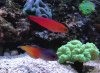
Mrs Cypho sure brings out some awesome colors in Mr Cypho.
He seems more interested in mating with her than killing her but he does occasionally get frustrated and nip at her. She looks fairly exhausted from constantly fending him off and has a couple more scaleless wounds, but she is eating well and I have not had to separate them yet so fingers crossed.
No aggression from anyone towards pictus, but he does not look so great, he arrived with a thin belly. After 24 hours he is still not eating and is still breathing rapidly.
He seems more interested in mating with her than killing her but he does occasionally get frustrated and nip at her. She looks fairly exhausted from constantly fending him off and has a couple more scaleless wounds, but she is eating well and I have not had to separate them yet so fingers crossed.
No aggression from anyone towards pictus, but he does not look so great, he arrived with a thin belly. After 24 hours he is still not eating and is still breathing rapidly.
Last edited:

Great looking fish, love seeing different pairs. You mentioned having these in the past correct?
Users who are viewing this thread
Total: 2 (members: 0, guests: 2)