

Banner image

jlanger's Reef Build: Episode II - The 120gal Strikes Back (1 Viewer)

The 120gal finally has a pair of angelfish.

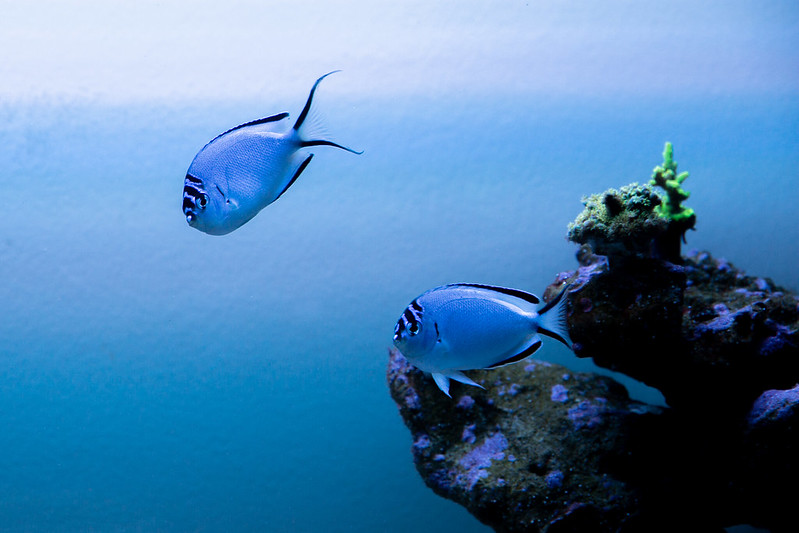
I have been debating with myself about the idea of moving on from finding a pair of G. semifasciatus. If I was to move on, I had a short list of angelfish that would be substitutes. As it so happened, New Wave Aquaria had a few G. lamarck angelfish available; one small and two very small ones. My internal debate took about fifteen minutes before I talked myself into buying two of the fish and try pairing them up in my reef. I picked up the larger and one of the smaller ones; about 3" and 1.5" in length.
The two fish are currently taking up residence in my acclimation box. (One that I built just over a year ago that I haven't used yet.) They will stay in there for a few days as I'm nervous with how the tuskfish will react to the newcomers. If I don't see any direct aggression, I'll release them into the reef. They're already eating the frozen foods that I feed the other fish, so that's a good sign.

Years ago, I purchased a very small Lamarck's Angelfish and it grew up to be a beautiful and perfect resident in my reef. That fish would eventually become the male Lamarck's Angelfish that is residing in the Augsburg University reef system. I'm excited to see these two fish grow up and become the focal point of my reef.

1618011463464.png

That is a 1.5" PVC pipe Tee fitting for some comparison.

In other news... there will not be an upgrade to that larger tank mentioned previously.
However... I'm already at the top of the list for a different system that is likely to be available within the next year.
 
I remember that old lamarck's, was gorgeous :) And so are these two little gals!

Why not Watanabei's though? ;)
Watanabei was one of the first swallowtail angelfish that I was attracted to, but not so much the male coloration. I really prefer the female coloration and patterns on the females of all the swallowtail angelfish, but there's only a few males that hold up; the Lamarck's and Japanese Masked are two of them.
 
Couldn’t agree more. I hope they both stay as females, however one already has the extended caudal streamers so it’s only a matter of time for mine.

How are your other fish doing? What’s the number up to after adding the two angels?
 
Last edited:
Couldn’t agree more. I hope they both stay as females, however one already has the extended caudal streamers so it’s only a matter of time for mine.

Hoe are your other fish doing? What’s the number up to after adding the two angels?
The females will exhibit the long streamers as the grow bigger. It's when you start to notice a change in colors that the transition is beginning. It seems that most species of swallowtails will have a yellow color show up; whether it be a patch on the body, the striping pattern or a crown on the head.

The other fish are all fat and happy. With the two new angelfish, I'll be at eight fish total.
 
Last edited:
Over the last couple of months, many of my goniopora colonies started to retract and a handful of them crashed and died out. My initial diagnosis was overcrowding so I relocated a few of them to give them more room and flow. Some of them responded well but the issues continued as most of them developed a possible brown jelly disease. Something else was going on with the tank so I started thinking about what could be wrong or missing.
My initial thoughts went way back to the issues that I had when I set up the tank. Maybe there was something missing biologically that needed to be addressed. I had been paying attention to a couple of new products on the market that deal with beneficial bacteria; specifically purple non-sulfur bacteria (PNS). I know the owner of Hydrospace and had a good discussion about the benefits of adding these bacteria into my reef. One of the benefits is that the provide a boost to consuming nitrates (of which I don't have an issue) and the other is "boosting the immune system" of corals against certain diseases [major paraphrasing]. I purchased a bunch of the PNS Pro Bio and the PNS YelloSno. I'm only into my second week of dosing so it's a tad early to see any significant change.

1619739779017.png

However...
I also wanted to rule out something else that I may not be seeing firsthand. I ordered both Triton ICP/N-DOC test kits to have samples tested just in case I have a rusting magnet or other contaminant in the tank. I also stocked up on new testing reagents as well. While doing a lot of major maintenance (spring cleaning) with the tank this past weekend, I discovered that my reagent for my Hanna Alkalinity Checker had been giving me false readings. It had been reading a steady 8.0dKH for the last couple of months. With the new reagent, the reading was 6.4dKH. :mad: Needless to say, this was most frustrating. I'm very good about doing water changes and testing my parameters regularly so this was the last straw.

And so it has come to this...

1619740383572.png

I reluctantly purchased the Trident to monitor the calcium, alkalinity and magnesium levels of my reef. I feel like I was the least excited person to ever purchase this piece of equipment. I prided myself on being diligent enough to handle my water parameters and testing without resorting to a machine. Oh well... what's done is done.
I just installed the unit yesterday and so far it's been smooth sailing. I've been dosing 2-part alkalinity solution to bring my alkalinity back up to more acceptable ranges and I'll be watching the Trident's results closely to see if I need to adjust my calcium reactor accordingly. (The calcium reactor is about due for a refill of ReBorn media anyways.)

So after all that, I believe the corals have been struggling due to the dropping carbonate levels.
The additional bacteria and coral foods may not be the remedy I needed, but I'm sure the reef will benefit from them anyways.

And here's a quick photo of the peanut gallery. These fish congregate to this corner of the tank any time I'm working on the scrubbers or anything else at my work station. They think they need more food, but they're all getting quite chubby already.
The the two new angelfish are doing extremely well. In fact, I found a piece of purple M. digitata broken off of the colony; just like the old days with the other Lamarck's. The little one likes to go after food much too big for it's tiny mouth.

1619740932950.png
 
FWIW over the past couple years my all hovered around 7 and occasionally dipped to as low as 5.4 with no ill effects, but I also don’t have any gonis so take it with a grain of salt. Hope you can figure it out. They are tough corals and have only been able to be kept long term in the last few years...
 
Have never heard of those products before, very cool! Interested to see if you notice anything as for as coral health goes. Sorry to hear about the rough times, but at least you are addressing things right away.

I’m sure you’re already planning on doing this but make sure to still test Alk at least once a week manually, just to make sure things are as expected with the Trident. I have a feeling it will grow on you over time though :)
 
It's been a while since I posted here, but there's been some excitement happening the last two months.

If you haven't seen my posts on Facebook, the pair of Lamarck's Angelfish are doing well; very well. After being in my tank for six weeks, I began to notice that the pelvic fins on the larger fish were getting some dark streaks on them. By the next week, the pelvic fins had completely turned black. The fish had begun its transformation from a female to a male.
I was quite surprised to see the transition happening so soon. My previous Lamarck's in the old 120gal system exhibited the fading of the black lateral line stripe as the first sign of transitioning. And that was after the fish had been in my care for at least a couple of years and the fish was about five inches long; this fish was still about three inches.
Within a few more weeks, the black lateral line had completely faded. Soon after that (within only twelve weeks in my system), the yellow crown started showing up. All that's left is for the base of the pectoral fin to turn into a bright blue patch before he's a fully transitioned male.
It'll be quite some time before I see any mating behavior as the smaller female is now about two inches long; much too small and young. Both fish are doing well as the newcomers to the reef. They're eating everything and are adding some girth to their size. They're not really interested in any of the other fish but the smaller fish is careful around the more boisterous fish; the larger angelfish and the harlequin tuskfish.

Here's the pair of angelfish.

1626053775004.png

Also evident in that photo is the aftermath of removing a lot of the plating montipora corals. The corals are growing quite rapidly and they needed to be trimmed. I ended up removing a cookie sheet worth of plates of the red and green M. foliosa. Those plates were either encroaching other corals or were getting too close to the glass. There's other places that need to be trimmed as well, but I have a little bit of time before they're a nuisance.

The issues with the goniopora corals is still present. I wonder if there's a pathogen (brown jelly-like disease) that's the root of the issue and it's being transmitted by my clownfish being hosted by the corals. I don't know.
But the clownfish does look happy in the corals though.

1626054196409.png

And if you have read the latest CORAL Magazine and were paying attention, you may have seen a photo of this "celebrity".
This fish is definitely the boss of the tank. It doesn't show any aggression towards the other fish, but it is always out front swimming the length of the tank inspecting it for any free meals. And when it comes to feeding, it is at the front of the line and goes after the largest pieces of food. Have you ever heard the popping sound the Copperband Butterflyfish's snout makes when snaps at food?

1626054458522.png

Other than that, I'm trying to get caught up with a few maintenance tasks that have been on hold the last few months. I need to clean and top off my calcium reactor, update the ATO with a new PMUP pump, set up the DŌS Pump to dose amino acids and trace elements and [im]patiently wait for the Neptune System SKY light fixtures to be available.
 
I love those Angels. I recently purchased a couple of female swallowtails and look forward to seeing one possibly transform into a male at some point. Thought about getting a couple Bellus angels but really liked the look of the swallowtails. Great looking reef and great looking fish you have
 
Great update Jason, and awesome photos. Still waiting on my watanabei to transition. I'm hoping pretty soon here.
 
Thanks to the generosity of a few of our members, build threads are once again popular and demanding updates. And seeing that I haven't updated my build thread or taken any photos in about five months, it's about time for me to do so.

The main reason for the lack of updates has been the lack of a reason to update.
The 120gal system has been running on autopilot for about a year. I haven't really added anything substantial to the system; equipment or livestock since this summer.
I am still running the same filtration setup from Day 1. I replaced the water pump on the skimmer as the old one crapped out; until I repaired it, so now I have a backup. I replaced one of the EB832 power bars as one of them crapped out; I will be replacing the switch on that so I have a back up. I switched my ATO pump from the DŌS to the PMUP so I can start using the DŌS as a dosing pump. I have not switched to a new lighting system; yet. And my APIS-300 Algae Turf Scrubber is still the workhorse of the system with keeping my nutrient levels in check from harvesting algae every two weeks.
The only real significant livestock "addition" was the Ornate leopard Wrasse. That fish was residing in my 32gal reef system, but I tore that one down earlier this fall and just moved the fish. I have added a second colony of Tubastraea which I love! I should have bought all eight colonies that were available; I like them that much. I'm still having random goniopra colonies melt away from whatever bacterial issue that is affecting them. I have picked up a few cheap goni frags to replace those that I've lost just to see if I'm getting past the worst of this malady. The Montipora corals have grown into a tangled jungle above some very large plates.
So realistically, my tank hasn't changed much in the last year. Corals are growing and fish are getting fat.

I dusted off the camera and snapped some quick photos of the corals and fish.
The Harlequin Tuskfish and the two angelfish are still camera shy; not even tempted with feedings. I'll be focusing on getting better [some] photos of them the next time. I'll be due for a FTS at year's end as well so I'll need to plant some of those newer gonis in the next couple of weeks.

Thanks for the motivation to update, @Fishfoo, @hinnenkm, @BlindSwordsman , @Fross and anyone I forgot.

Enjoy the pics.
If you look closely, you'll see that the best location for fish photos is directly infant of the two Tubastraea colonies; it's a bottleneck for traffic. And it's where I feed the most as I try to make sure the Tubastraea gets something to eat each day; but the fish also know that it's easy pickings right there.

These two fish run the reef and must be in charge of getting more food; they beg non-stop and they're already pigs!

1639003368823.jpeg

The "other" tang; the Kole Tang.

1639003433568.jpeg

A quick flyby from the Harlequin Tuskfish.

1639003559314.jpeg

The other two wrasses; the Ornate Leopard Wrasse and the Melanurus Wrasse. They didn't get along at first but that's all changed now.
In the photo, you'll see the Bernardpora Garden behind one of the Lobophyllia colonies and the grafted Montipora. The garden is being shaded by a large plating red Montipora foliosa that will be severely trimmed this month.

1639003602858.jpeg

Here's an update to show the markings on the male Lamarck's Angelfish.
Later in the evenings, prior to lights out, the male will perform parade laps to entice the female. When she decides to follow him into the open water above the reef, he will turn flat on his side and shake his tail at her. She doesn't pay it much attention yet; they're both still quite young, but it's promising to see.

1639003783864.jpeg

The new Tubastraea colony; so bright and orange!
I want more, more, more!!!

1639004007088.jpeg

A close up of a couple of the Bernardpora colonies in their garden.

1639004079736.jpeg

A few frags of a Rainbow Bernardpora that need to be planted or sold/traded someday soon before they encrust onto the Slide-Loc frag rack.

1639004136801.jpeg

This is the Blue and Pink Lobophyllia that I nabbed from @ChristopherKriens before he fled south. It originally had two heads but over the summer, one of the heads divided for a third head and a fourth one is just about complete.

1639004325369.jpeg

Let's hope that I add more photos very soon and not wait for another five months like I did here. I'm planning to dust off the porthole for some topdown shots and finding a way to get some clear photos of those fish that are camera shy.

Thanks for stopping by.
 
Those sun corals are beautiful 😍 are they hard to keep happy?
 
Those sun corals are beautiful 😍 are they hard to keep happy?
So far, no.
I feed my tank pretty heavy so there's plenty of food to go around. I do have a long pipette that I will target feed the colonies but I also need to distract or fend off the Copperband and Yellow Tang from stealing any caught morsels. I do add some smaller food options to my frozen food blends that the fish may not want but the corals will eat; i.e. PE Calanus, crushed PE Mysis Flakes and other coral foods. As long as I see them grabbing some food every day, I am happy.

My only complaint is that it's tough to find healthy colonies of a decent size. And if I find a colony, they're priced quite high even when you don't know if they're eating or not.
 
Its a coral I've been looking for recently. But what people want and what I'm willing to pay are two different things. Crazy how things change mainly prices.
 
I’ve been watch Jake Adam’s talking about some bacterial issues with Euphylia and he’s been using chemi clean as a treatment. Not sure where you are at with the bacterial issues or melting of the gonis at this point, but might be something to look into if the issue persists.

Tank is looking great though!
 
I’ve been watch Jake Adam’s talking about some bacterial issues with Euphylia and he’s been using chemi clean as a treatment. Not sure where you are at with the bacterial issues or melting of the gonis at this point, but might be something to look into if the issue persists.

Tank is looking great though!
I've heard the ChemiClean theory but I haven't given it much attention, yet.
I should go look up more information on it. Thanks for the reminder.

Here's one of the currently afflicted gonis.

211206 - GonioporaIssuesjpg.jpg
 
I spent a little bit of time addressing one of the issues on the reef this weekend.
One of the plating red M. foliosa colonies has been growing rapidly and completely shaded the corals placed beneath it. Those corals are the Bernardpora Garden, so they don't need the brightest of light but they do better when the get some direct light. I decided to remove the large single plate covering that area.

Here's the before photo showing just how big this plate had grown and how you can barely see any of the corals on the rock beneath it. I've had to break off sections of this plate many times before so you can see some erratic growth forms as it intermingles with the green M. foliosa, an Idaho Grape Montipora and a grafted monti frag.

211210 - MontiporaPlates.jpg

I used a scissors to cut the coral just under the ridge that appears on the right side of the big plate; that shadow line. The coral snapped off on one large piece and it measured at 11 inches by 7 inches. The first thing that I did was flip the removed plate over and I found a few places that contained Montipora Eating Nudibranch egg clusters. No nudis where on the plate, but there's evidence that they're still in there. Come on wrasses, earn you keep! Needless to say, that coral went straight into the trash.

211211 - MontiporaPlate.jpg

Another are that I haven't shared recently is the Montipora digitata forest. These corals have grown into a thick tangle of coral branches. I notice that branches do get broken off (most likely by chasing fish) and then fall down into the thicket and then just grow back out.

211210 - DigitataForest.jpg

I didn't take any photos after the maintenance was performed as the fish were all spooked and wondering where that nice big shelf disappeared to; many of them used it for cover. But at least the Bernardpora are getting some direct light again; for now.
 

Users who are viewing this thread

Back
Top