Banner image

Reef #2 - The Unplanned Upgrade (1 Viewer)

Dang ok so I should be using lanthium in the rock I’m soaking in RO water after a muriatic bath to pull the phos out? I’ve been changing out the water weekly and it’s stinky.

 
Interesting. Especially after acid. I did acid and bleach, now in saltwater. It’s only been there for 3 days, so I don’t yet know how stinky it is or will get. But as you know I read a lot, and lanthium seems like the go to answer for stripping the phosphate out in these types of cases, to help it from binding in the rocks.

I know my first tank I bleached the rock and then soaked it in SW for ~2 weeks only. And ever since I struggled with phosphate being >0.7-0.9ppm. Running gfo helped, but I could deplete the gfo in my reactor in days (when research said it should last weeks). So…definitely trying to do it better this time :)
 
Don't forget that LaCl will cause the phosphate to bind with it and form a particulate. You will want to make sure you rinse off the rock really well once you are ready to use it so that you don't carry it into the tank. It won't hurt anything, but you could end up with a white film if there is enough of it left.

Research LaCl reactors to fix up your existing tank. I built one of these if you're interested:

 
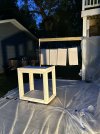
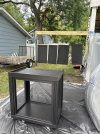
Quick update. I finally got the stand painted.
IMG_2760.jpegIMG_2762.jpeg
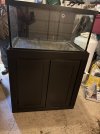
IMG_2799.jpeg

I’m super happy with how it turned out. Next step is to get the plumbing updated, leak test, then get it in the house.

With regard to the rock, that seems to be coming along well. I’ve been dosing Microbacter 7 with ammonia. I dosed about 1ppm and after a few weeks it’s down to 0. So I just dosed it back up to 1ppm and I’ll see how quickly it processes it. But I’m happy to see something is happening.

I also have done some phosphate testing. After a few weeks the phosphate was up to 0.29ppm. Similar a week later. So I dosed some lanthium and it came down to 0.1ppm. I’m going to leave it there for now to make sure there is a little in there for the bacteria, but if it stays there for another week I will dose a little more lanthium to drag it down to 0.05 or so. I was very happy with how quickly it worked.

Overall, things are going well I think. And I think I’m still on track to get the outside wet stuff done before the freeze. Fingers crossed.
 
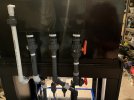
Update on the last big step before it can come in the house, the plumbing. Right now I just have stuff dry fit (so unless someone has tips on how to actually get pvc to go all the way together, you’ll noticed that things don’t line up exactly where they will once I finally glue it). But I figured since this is my first time ever plumbing a sump, I would check to make sure I didn’t do stupid things. First pics and a video, then some thoughts from me:


IMG_2902.jpegIMG_2901.jpeg
IMG_2900.jpeg

First you’ll notice 2 valves on the main return (it’s a bean animal as you see). Originally it had a ball valve but I decided to add a gate valve. But as the union bulkhead was directly into the synergy reef overflow box, I don’t know how to remove that valve, so I guess I’ll leave it and just leave it open.

You see I added a manifold. In the final glued state that grey clamp will actually mount to the 2x4 above it. I left that 3/4” extension to the left with the thought that if I ever wanted to add a third valve I could cut off the cap and extend it. But with how it gets close to the gate valve, perhaps I should just put a 90 for the second valve instead of a T and stop at 2.

I put a true union BV at the manifold connection per the sage advice of @zoolan70 so that I could remove the manifold for cleaning/upgrades.

So, thoughts? Feedback? Basically nothing is glued. Some of the original pipes (like the emergency drain) I’m reusing, so it is fully glued. But effectively anything can change. So I welcome any feedback that can help make this better.

Thanks in advance. I’m hoping with some good feedback to get it all glued this weekend and to then start the leak test. After that I can finally move it into the house to prepare for the transfer. Can’t wait.
 
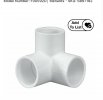
Oh, one more thing. One part I don’t like is how far the return pump inlet to the hard piping sticks out over the sump. I wish it was all towards the back just to free up some real estate. As such I was googling and saw these 90 degree elbows with a side outlet:

IMG_2904.jpeg

That could allow my return pump to be right at the back of the sump/stand. I assume it’s a little more head loss, but maybe not a huge concern when the overall vertical from return pump to top of tank is ~4 feet. It’s a Sicce 6.0 (400-1600gph) on a 65 gallon tank. The pump curve says a 6.6ft of head (seems conservative) the pump still can produce 800gph. If I’m aiming for 3-4x turnover, that still leaves plenty of room on the pump it seems. Thoughts?
 
This looks really good!

As for dry-fitting, I've found that seating the PVC all the way into the fittings can lead to more trouble than it is worth. You'd be surprised how tight those fittings can get, even without glue.

If you think you may want a third manifold outlet, just add it now. Your comment about the gate valve is 100% correct, but I think you could put the 90 where the cap is now, and you can fit that third manifold outlet union valve in there almost perfectly.

Let's get that thing moved in the house!
 
Oh, one more thing. One part I don’t like is how far the return pump inlet to the hard piping sticks out over the sump. I wish it was all towards the back just to free up some real estate. As such I was googling and saw these 90 degree elbows with a side outlet:

View attachment 64148

That could allow my return pump to be right at the back of the sump/stand. I assume it’s a little more head loss, but maybe not a huge concern when the overall vertical from return pump to top of tank is ~4 feet. It’s a Sicce 6.0 (400-1600gph) on a 65 gallon tank. The pump curve says a 6.6ft of head (seems conservative) the pump still can produce 800gph. If I’m aiming for 3-4x turnover, that still leaves plenty of room on the pump it seems. Thoughts?
If your goal is to move the hose barb back on that return line, I would use a street elbow right off of the T to the manifold, and put your 3/4 slip to 3/4 female thread bushing in there, and call it good. Get rid of both of those 45s. I don't think the pressure loss will be any different (and possibly better) than that 3-way elbow and not even a big difference over the two 45s.

If you want to see some other neat PVC fittings you could play with, check out https://flexpvc.com/.
 
Haha, thanks Tim. That’s a fun website. Lots there for sure. And fair point on the street 90. That would definitely save 3-4” I’d guess. I kept that fitting and the T 1” and then everything else was 3/4”. I guess in reality any benefit to those couple fittings being 1” vs 3/4”? Probably doesn’t matter much either way.

Regarding the manifold, I don’t know that I need or have any plan for it, it was just future proofing. Right now I’m only thinking the ATS on one and the other as a flex for a gfo reactor or otherwise. But for such a baby tank maybe thinking about a massive manifold is silly anyway? Can’t have it all I guess.
 
Okay, I got it all glued up tonight. Overall it went well. The final joint between the vertical return line and the manifold got a little hairy, but overall just your typical solvent laden PVC session :). I'm going to let things cure overnight and get the tank wet tomorrow I hope to check for leaks! I can't wait.
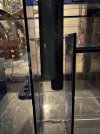
That being said, one more quick question about the length of the overflow pipes in my sump. Again, I'm running a bean animal overflow, so I have a primary drain (with gate valve), secondary drain, and emergency drain. I have the primary and secondary going into the main return chamber and the E drain in a later chamber. I think it's my understanding that the primary/secondary should be BELOW water level and the E drain should be above. Here is where the primary/secondary ended up in my sump:

Overflow length.jpg

So they're obviously well under the water level. My question is, can I safely cut them to be just ~1-1.5" longer than that baffle in the picture? I believe that is the level that chamber will always stay at, because it fills that chamber then overflows into the sock chamber. I'm just thinking to keep them as short as possible will make it easier for me to remove them in the future once the tank is in it's final position. Thoughts? It won't stop me getting the tank wet tomorrow, but before I do the final install I would cut them to length.

I've also seen people cut a 45 degree angle on the bottom. I have no idea what that would help in this environment, but I'm open to learn.

Can't wait to see some water in the tank!
 
You can cut them shorter for sure but I would leave a couple inches submerged.
 
The 45-degree angle is typically needed if you make the pipe go almost all the way to the bottom. If you end up too close to the bottom and don't cut the pipe like that, you can actually cause back-pressure up the line. You won't need to worry about it.

You are correct that the baffle height of that drain chamber is the level that the water will be at all the time. You can have both of these drains underwater but I would leave your emergency drain out of the water so that it makes the max amount of noise possible.
 
The tank got wet today! Hooray. I got it filled and ran it for about 3 hours this evening to leak test it:


Sadly I have one minor leak in the synergy reef overflow. One of the two bulkheads had a tiny tiny drip. So I have to figure that out tomorrow. I have an idea, fingers crossed that’s it.

Otherwise I’m pretty happy. I was able to tune the overflow itself to be totally silent, but it’s still noisy in the sump in the filter sock area. Perhaps I need to raise the water level a bit so it doesn’t fall/splash so far. I’ll play with that tomorrow.

Getting closer.
 
You should be able to tighten the nut a bit and maybe that will stop the leak, however if those gaskets are still original and that tank has gone through 2 moves and a replumb I would recommend getting some new ones from Synergy.
 
Thanks Ben. So I actually just about ordered new gaskets when I read on Synergy’s own website that the gaskets never need to be replaced unless they are torn or physically damaged. That they should just be washed with soap and water. Maybe it was a dumb move, but I “trusted them”.

My running theory is that I installed some little pipe clamps per their recommendation to take some of the weight off the box. But upon inspection of the leak I see that the pipe clamp causes the overflow box to actually push away from the tank at the bottom a tiny bit. So I’m wondering if it’s “torquing” the seal. I’m going to remove the clamp and see if it fixes it. If so I’ll see if I can shave down the mounting base of the clamp so that it still holds the pipe but doesn’t torque the seal.
 
Oh right on that makes sense. I guess it takes a LONG time for rubber to get hard.
 
Yea they still felt good. I admit that I felt a bit cheap not just replacing them. But when the company itself wasn’t trying to actively sell me new ones…I figured it was maybe silly.

Believe me, I plan on installing the tank far enough away from the wall that I can drain the tank slightly and replace them if it ever becomes an issue.
 
Well I “think” I got it. I removed the bracket and the leak went away. Modified and reinstalled the bracket and it came back (doh). But I felt like it shouldn’t be quite so finicky, so I slightly tightened the bulkhead with a pipe wrench (it claimed finger tight should be enough…maybe I’m just too weak). I put maybe a 1/16 of a turn and I haven’t seen anymore drips. Going to run another 24 hrs to be sure.

The only problem I have now is getting the overflow dead silent. I’m not sure if I need to adjust the pipes inside to offset their height more or what, but this is what happens.

Starting with the gate valve on the main wide open it’s really noisy, tons of air, and the water level is low in the overflow. As I close the gate valve the water level rises and approaches creating a full siphon. The main drain goes silent and the bubbles stop coming out the bottom. But RIGHT when that happens I start getting bubbles and noise in the secondary drain. So I’m wondering if it’s too low and too much starts to come through?

In any case I seem to never be able to get the main drain to form a full siphon. Not sure why. Any tips on what I might be doing wrong?
 
You want just a small amount coming though the secondary.

I’ll say these 2 things that may help:

First, if you are just testing with fresh water don’t make your judgement off that, it will behave differently with saltwater :)

Second, After cursing that Synergy for being so finicky I have a Modular Marine on my new tank and I very rarely have to adjust it. They are functionally the same, the only difference being Synergy uses those weird proprietary U tubes on the top of the pipes. On the modular Marine I just have a slip bulkhead screen going into the full siphon with no riser pipe, and a 45 on the secondary riser pipe and it has given me nowhere near the trouble of a Synergy. Worth trying as it costs almost nothing and you can experiment now before the tank is running?
 
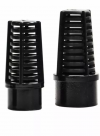
Hrm, I’m trying to understand what you mean by a slip bulkhead screen. Just something like this?

1698027838647.png

The 45 I understand, and you have it just high enough that you get the water level you want in the overflow box with barely any water going into that secondary?

I’m definitely willing to play around. Looking at the weather forecast it seems I have about a week :).

And interesting that it will be different with saltwater. I could understand that the final valve position would be different, but I assumed if I can’t make it silent on freshwater, I won’t be able to make it silent on saltwater?
 

Users who are viewing this thread

Back
Top