

Banner image

jlanger's Reef Build: Episode II - The 120gal Strikes Back (1 Viewer)

Hungry corals are healthy corals! Looking great dude. Love me some NPS!

How often do you target fed em?
 
Hungry corals are healthy corals! Looking great dude. Love me some NPS!

How often do you target fed em?
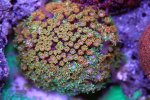
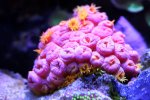
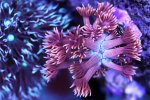
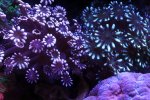
I would say that they get "target" fed every time that I feed. The corals are mounted in a spot where when I dump in food for the fish, the water flow carries the food through that location. As the fish go after the larger pieces of food, the corals are able to snatch many of the smaller pieces. I do actually target feed them with a pipette every couple of days though. When the corals are fully extended like that looking for food, it's hard to resist giving them something to eat. The only issue with that is the fish will come by and pick the larger bits from the corals. But I don't believe that's much of an issue as these corals are all putting on weight and adding more polyps; they're even peeking out from the underside. These are some tubby Tubastraea.

220210 - TubbyTubastraea.jpg
 
I finally took the time this past weekend to take a large number of photos of my reef now that it has recovered from whatever bacterial pathogen (arcobacter???) decimated my goniopora collection.

The corals.
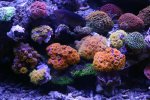
The surviving (and new) flowerpot corals have been mounted onto the reef. The Alveopora Garden moved to the left side. The Bernardpora Garden has moved to the right side. The Goniopora Gardens occupy the top rock and main shelf. Some of the lobophyllia spp. corals have been repositioned to give them more attention. The Montipora digitata forest is growing like weeds and requires pruning; hence the dark hole near the center of the frame. The plating Montipora corals are continually getting trimmed back. And the newest garden is for the Tubastraea; now at ten pieces including three green/black frags.

The fish.
No new additions to report. The pair of Lamarck's Angelfish continue to bond. I haven't seen any successful spawning yet, but they practice and dance every night.

The system.
No new equipment or maintenance changes to report. The algae scrubber continues to perform very well with manageable nutrient levels; as expected. The calcium reactor is doing its job. The protein skimmer is keeping my pH levels elevated with the fresh air being brought in from outside. I am really liking the SKY fixtures; great light spread and visually outstanding.
I have started dosing a new product; Captiv8 Aquaculture's Isol8 MT. It's an additive that was designed to help replace minor and trace elements that are depleted from running an algae turf scrubber. I had sent in a batch of ICP water samples and they reported a handful of elements as depleted or non-detectable; most notably iron.

Enough of this... PHOTOS!

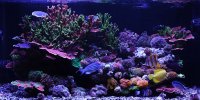
FTS. Note: All nine fish are accounted for in one photograph!

220626 - FTS.jpg

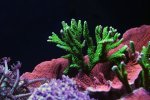
Close up of the green M. digitata and red Montipora foliosa corals.

220626 - GreenDigitata.jpg

Way in the back, I have a couple frags of the German Blue Polyped Digitata. It's a striking blue color and I cannot wait to have these grow out into larger colonies like the rest.

220626 - GermanBluePolypDigitata.jpg

A close up showing the polyp of the grafted montipora.

220626 - GraftedMontiopora.jpg

I'm still enjoying this coral as it grows. I started as two large polyps. The back polyp is now three separate polyps and the front polyp looks like it's going to follow suit.

220626 - Symphyllia.jpg

A couple of new Alveopora pieces added to the garden.

220618 - Alveoporas.jpg

Photos of a few of the Bernardpora (Goniopora minor???) corals.

220626 - DNFireGardensBernardpora.jpg
220626 - PixyStixBernardpora.jpg
220626 - UCSweetLipsBernardpora.jpg
220626 - RainbowTrollGoniopora.jpg

Some of the new Goniopora corals.

220626 - BlueTipGreenGoniopora.jpg
220626 - IndoPinkGoniopora.jpg
220626 - ASDSuperSonicGoniopora1.jpg

220626 - RainbowGoniopora.jpg

And finally, my newest crush... the Tubastraea Garden.

220621 - TubastraeaGarden.jpg

What I have yet to mention is that I expect to add more Goniopora corals from attending MACNA and Aquashella -Chicago later this summer and fall. I'm expecting that I will need to thin out the gardens at that time as they will be too crowded. That is a much better problem to solve than having multiple corals mysteriously and continually dying like last summer.
 
Last edited:
I finally got around to uploading the video (HD/no audio) taken around the time off the previous photos; June 26th, 2022.
This is the video that was submitted for the Reef Beef podcast; Episode 59.

 
Last edited:
Summertime is when most our aquariums become afterthoughts as we find more enjoyable [outdoor] activities during this time of year. However, I find myself spending a lot of my attention on my reef this summer. Maybe this is because last year was a complete buzzkill or it is due to more attention from outside interests that have kept me engaged over the last few months. Whatever the reason, I am very happy with my reef. Healthy fish. Healthy corals. Healthy environment.

I'm making this post to document on a few of the things that I have been working with on my system.

Foremost, I have been very involved with tracking the performance of my algae turf scrubber; Foursquare Aquatics' APIS-300.
For the last two years, I have documented every harvest. Every time, I take photos of the screen (both sides) prior to harvest and a photo of the harvested algae being weighed (after squeezing out the water). When I feel it needs to be documented, I will take other photos or video during the harvesting process. Having all of these photos gives me a resource that I can use to help identify any possible changes to my water quality or to make adjustments to the scrubber to adapt to those changes.
For the last year, I have been maintaining very consistent nutrient levels; nitrates at 24ppm and phosphates at 0.10ppm. I have seen that the brain corals (lobophyllia and symphyllia) look better with these levels of nutrients. At lower nutrient levels these corals appear constricted and not as fluffy, so I keep the nutrients up. Sure, the glass needs to be cleaned more often but it's a trade off that I am willing to make.
A couple of months ago, I started documenting how much food I am adding to my system every day. I have limited all of my feedings to only the frozen foods; no coral foods, no bottled foods. I have been feeding LRS Reef Frenzy/LRS Fish Frenzy and PE Mysis. I weigh each food and write it down to keep a record. On average, I am feeding about 20g of frozen foods daily. The frozen foods not only feed the fish, but I also feed the Tubastraea corals daily as well. What tracking this information will tell me is unknown but it could be helpful in determining how efficient algae is at pulling out nutrients. (I would need to know how much nitrate and phosphate is available on the foods.)
Around the same time as documenting my food input, I started dosing a supplement by Captiv8 Aquaculture called Isol8 MT. It was designed to replenish the minor and trace elements that are commonly deficient when utilizing algae as a filtration method. I started dosing this supplement as I had received my ICP test results that showed my system was missing or deficient in a number of elements. It just so happened that these were all of those same elements. Once I started dosing these elements, my algae production bumped up and the corals also responded favorably to the replaced elements being back in the water.
And most recently, I changed the photoperiod of the lights for the scrubber. This idea came from @Jposch. He was running a "weird" lighting schedule on his scrubber and was getting a CRAZY amount of algae growing in his algae turf scrubber. I was very intrigued and decided that I wanted to see if his practice would work on my system. The idea here is that the lights cycle through multiple on/off periods throughout the entire day. This provides multiple opportunities for the algae to respire each day. (I am a firm believer that algae needs a dark period for respiration to be most effective; running the lights on any algae filter 24/7 is not the way to go.) I programmed my lighting schedule to have eight hours of light overnight and then there are four one-hour periods of light set in the morning and evening. This "staggering" of the photoperiod allows for five periods of darkness for the algae to respire. I have been running this staggered photoperiod on my scrubber for the last month and it's been a game changer. The amount of algae produced during the last two cycles has doubled even though nothing else was changed. I am still running the lights for a total of 12 hours per day. Upon inspecting the algae scrubber on Thursday, I realized that I needed to harvest the algae early. If I let it go for another day, I would've filled the drawer completely with algae and possibly caused some issues. In just twelve days, I harvested 812g of algae. And the most important change from this "experiment" is that my consistent nutrient levels dropped significantly; especially the nitrates. The stable 24ppm of nitrate dropped to 11ppm in just twelve days. I plan to run this staggered photoperiod for another two months to verify the results and make sure this is not an outlier. I will be testing the water every few days to make sure that the nutrients do not bottom out. If they do, I have bottles to boost the levels back up and I will likely adjust my lightning schedule to a lesser amount of total light per day; back to ten hours per day.

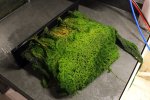
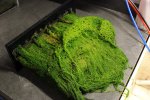
Anyways, here's some photos of the latest algae harvest.
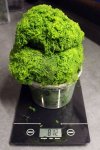
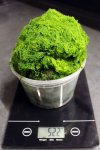
Twelve day cycle. Twelve hour staggered photoperiod. 812g (squeezed) of algae.

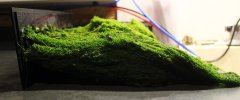
220721 -AlgaeSlab1.jpg
220721 -AlgaeSlab2.jpg
220721 -AlgaeSlab.jpg220721 - AlgaeWeight.jpg

As you can see in the photos, the algae is very clean and viable. There's very little slime algae on one edge of one side; if you want to call it slime algae. The algae was still firmly attached to the screen as there was no die off of the algae underneath from the algae being so thick. And there was no stink from anything decaying; all fresh algae.


And for those of you not interested in algae filtration, I did manage to capture some decent photographs of some of the more reclusive fish in the reef.

The female Lamarck's Angelfish above the Bernardpora Garden.

220719 - LamarcksAngelfishFemale.jpg

The Harlequin Tuskfish.
Yeah!!! A decent photo!

220719 - HarlequinTuskfish.jpg

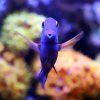
And I really like this Kole Tang selfie.

220719 - KoleTangSelfie.jpg

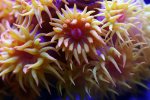
And just another photo showing the stunning beauty found within individual Tubastraea polyps.

220719 - TubastraeaMacro.jpg
 
My lighting for the scrubber is:
05:30-10:00 ON
10:00-10:30 OFF
10:30-15:30 ON
15:30-16:00 OFF
16:00-21:00 ON
21:00-21:30 OFF
21:30-23:30 ON
23:30-00:00 OFF
00:00-05:00 ON
So, much more on time, and I actually need to cut this back significantly since my tank is completely bottomed out on N&P now. This is on a 250 net gallon tank that is coral only and rarely fed. The isol8 MT is on the list since I'm sure my trace elements are completely burned up.
 
For what it's worth I was a biology major for a time and I have flashes of painfully obscure facts.

As I recall all plants have a respiratory cycle made of several stages and stages in those stages... such as the Krebs cycle. The photosynthesis of course takes place in the day and requires lights. The "dark cycle" actually is not *needed per se as it happens regardless of the presence of light.

The caveat (where I start to get fuzzy) is that some plants are so effective at producing during the light period they cannot store any more energy for the following parts of the respiration cycle... kind of like the governor kicking in on a golf cart. It was accelerating great until it hit a "compensation point". I also think I remember that this excess of stored energy is detrimental after a time, at a minimum significantly inhibits the cycle.

In your case I strongly suspect that some or all parts of your design is making the photo period so effective that the bank fills up and needs down time to catch up. The light spectrum, intensity, availability of nutrients...

With your more efficient down time strategy they are producing during more total hours of the day vs. being a capacity pause (compensation point). *edit* with a longer night cycle it likely ran out of energy in the bank and thus stopped producing.

Since there is not minimum night cycle you can then modify the length of the light period to know the minimum to get up to capacity. It's entirely possible that the amount of time able to be at a peak photo period is quite short.

I did find an article that peak photosynthesis occurres at 68 degrees though other factors can play a meaningful part.
 
Last edited:
Watching your numbers on this could significantly elevate the viability of an ATS.
I do think even more cycles in a day would be better, like 1 hour On, 5min off, but my current timer only allows so many cycles. I do think an ATS is significantly more capable than they are made out to be due to improper understanding of photosynthesis and respiration.
You hit the nail on the head behind the idea of shorter photo cycling to increase production. Like with coral or plants. Algae too can become photosaturated under intense lighting and that inhibits growth, and plant health and production suffers. Fwiw, the APIS-300 has two 84watt (actual draw) lights. Most ATS with a similar screen size utilize pretty weak lights around 20-30w (actual draw) on each side. Essentially, the APIS lighting is IMO too intense to being operated on a typical 12:12 cycle. As @jlanger has pointed out, our experiences are not entirely valid compared to a proper research study with control tests as well as other parameters being modified in a strict manner. I feed on a sporadic schedule, feed different foods entirely (mainly DIY blend on amino acids, vitamins, yeast, egg yolks, etc.) I use a different feed pump for the scrubber. I also don't usually scrape the screen either. I just give it a trim with scissors most times.
 
Edit* in a peak performance scenario you would have the light cycle run long enough to fill the bank but not longer.

You would want the dark to run long enough to depleat the bank without going broke.

The added dosing would certainly help to limit variables that could give a false reading of the ideal light cycle for your scrubber... and I'd think it would be a fairly unique cycle to your scrubber.
 
Edit* in a peak performance scenario you would have the light cycle run long enough to fill the bank but not longer.

You would want the dark to run long enough to depleat the bank without going broke.

The added dosing would certainly help to limit variables that could give a false reading of the ideal light cycle for your scrubber... and I'd think it would be a fairly unique cycle to your scrubber.
Without lab grade equipment, how does one measure photosynthetic efficiency/productivity? I think guess and check is about the best we can do. I also drip kalk slurry 24/7 in my tank. So, that not only keep pH elevated and co2 (carbonic acid) near non-existent, but it also precipitates some phosphate as well. I suspect in most cases, pushing a scrubber to maximum capability is way overkill and likely to strip nutrients to levels low enough to be problematic. Although the Foursquare units are much more than the competition,I was happy to support the small LOCAL business as well as the convenience of the pull out drawer. 1/4" polycarbonate construction is also super durable. I've dropped the try on concrete a few times already. Lol
 
I think the throught is simply to show how to optimize the light period then a user can easily increase dark periods from there to limit uptake.

Experimentally I'd think the "simplest" approach (and one used in science) is dry weight which is essential being done already.

There are primarily only two variables you want to change and then of course try to keep the various elements at the same level.

Since the current production is getting established then keep the number of photo periods the same and:
1) increase the length of each photo period without shortening the dark period.
2) reset back to the original and so the same with the dark period.

Each would effectively isolate the near optimal range and produce a bell curve of results.

*Increased/decreased element uptake should be a much faster method of noticing change.
 
An oximeter and pH probe in the drain could perhaps identify changes as well but I would think it would be harder as each light and dark period would independently need to be cross-checked on the previous days time slot and not relative to the day as a whole.
 
I'm enjoying the discussion here with methods to find the optimal operational settings for algae turf scrubbers. @RSnodgrass @Jposch
I do plan to keep the same settings for the next two months. I will be monitoring the results of the nutrient levels very closely and will make changes if necessary. I [we] must remember that this is my display aquarium and the health and livelihood of the animals within are the highest priority. If I had the resources and time to set up multiple testing systems, I would definitely be eager to run more extensive experiments.
 
Eight days later...

220729 - AlgaeWeight.jpg

Other than the staggered 12-hour photoperiod, nothing else has changed to my husbandry/routine practices. I am still feeding heavily. I am still dosing minor/trace elements and aminos. In fact, I have not performed a single water change in the last four weeks. Here is what has changed; nitrates.

Over the last year or so, I have maintained my nitrate level around 24ppm; sometimes as high as 32ppm.
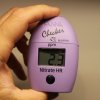
Here's a timeline of nitrate test results (Hanna HR Nitrate Checker and Red Sea Nitrate test kits) over the last three weeks.
July 9th: 28.6ppm.
July 21st: 11.1ppm.
July 26th: 6.9ppm.
July 29th: 2.3ppm.
Oh oh. I need to start doing something to get the nitrates back up; dosing nitrates or going back to a "standard" photoperiod.

220729 - NO3Checker.jpg
 
Watching your numbers on this could significantly elevate the viability of an ATS.
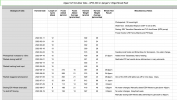
Numbers? Here's some numbers.

It's been a few weeks so here's a quick update and some data.

Prior to the first changes made in April, my APIS-300 was consistently keeping my nitrate levels around 12-16ppm with a 10 hour photoperiod.

You can see that there's an increase in algae weight when I increased feeding for the NPS corals in March; nitrates also jumped above 24ppm.
There's another increase in algae weight when I started dosing Isol8 MT to replenish those depeleted minor and trace elements associated to algal filtration.
And there's the significant increase in algae weight when I started the staggered photoperiod in July.
The algae weight begins to drop off in August when the nitrate levels start declining rapidly and eventually bottom out. Nitrates dropped to 2.3ppm on July 29th and I began dosing ESV Nitrate to get above 10ppm. Due to a busy/bad week in August, nitrates bottomed out at 0.0ppm on August 17th. I am now dosing 20ml of nitrates daily until I reach 16ppm again.

Here is perhaps the more important observation.
When looking at the records for July, you can see that the daily food inputs drop while the "daily" algae weights continue to rise thus causing the nitrate levels to rapidly drop.


I did not include any phosphate test results as I wasn't confident in the results my testing was giving me. The Hanna ULR Phosphate Checker was giving me +0.90ppm errors up until August 3rd while the Red Sea test kits were giving me results around 0.10ppm. Since the Hanna checker started registering readable results two weeks ago, they have dropped from 0.82ppm to 0.28ppm. The Red Sea kit still shows much lower results but I am now out of reagents.

Water samples have been collected to send in for ICP testing.

Screen Shot 2022-08-20 at 10.50.33 AM.png
 

Users who are viewing this thread

Back
Top